The “Natural” Sugar Myth:
Why Honey Isn’t Healthier Than White Sugar
Both are sugar. The WHO, the FDA, and the American Heart Association all agree on that, even when the label art disagrees. Here’s the chemistry, the regulatory paper trail, and the psychology of why one of them gets to wear a halo.

The glow is real. The health claim attached to it is doing more work than the evidence supports.
Picture two jars side by side on a kitchen counter. One is matte white, machine-poured, faintly industrial. The other is amber, viscous, backlit by a window — the kind of jar that ends up in the background of a slow-living photo with a wooden spoon resting across the top. One of those jars feels like a confession. The other feels like a lifestyle.
That feeling has very little to do with what’s actually inside either jar. Honey and white sugar are both, overwhelmingly, sugar — and the World Health Organization, the U.S. Food and Drug Administration, and the American Heart Association have all, independently, arrived at the same unglamorous classification: honey counts as a free sugar, full stop, the same category sucrose sits in.
This isn’t a takedown of honey. It’s a look at what the research actually measures once you strip away the amber lighting — the real gap between the two sweeteners, where that gap is genuinely meaningful, and where it’s a rounding error wearing a marketing campaign.
What’s Actually in the Jar — The Fructose, Glucose, and Water Math
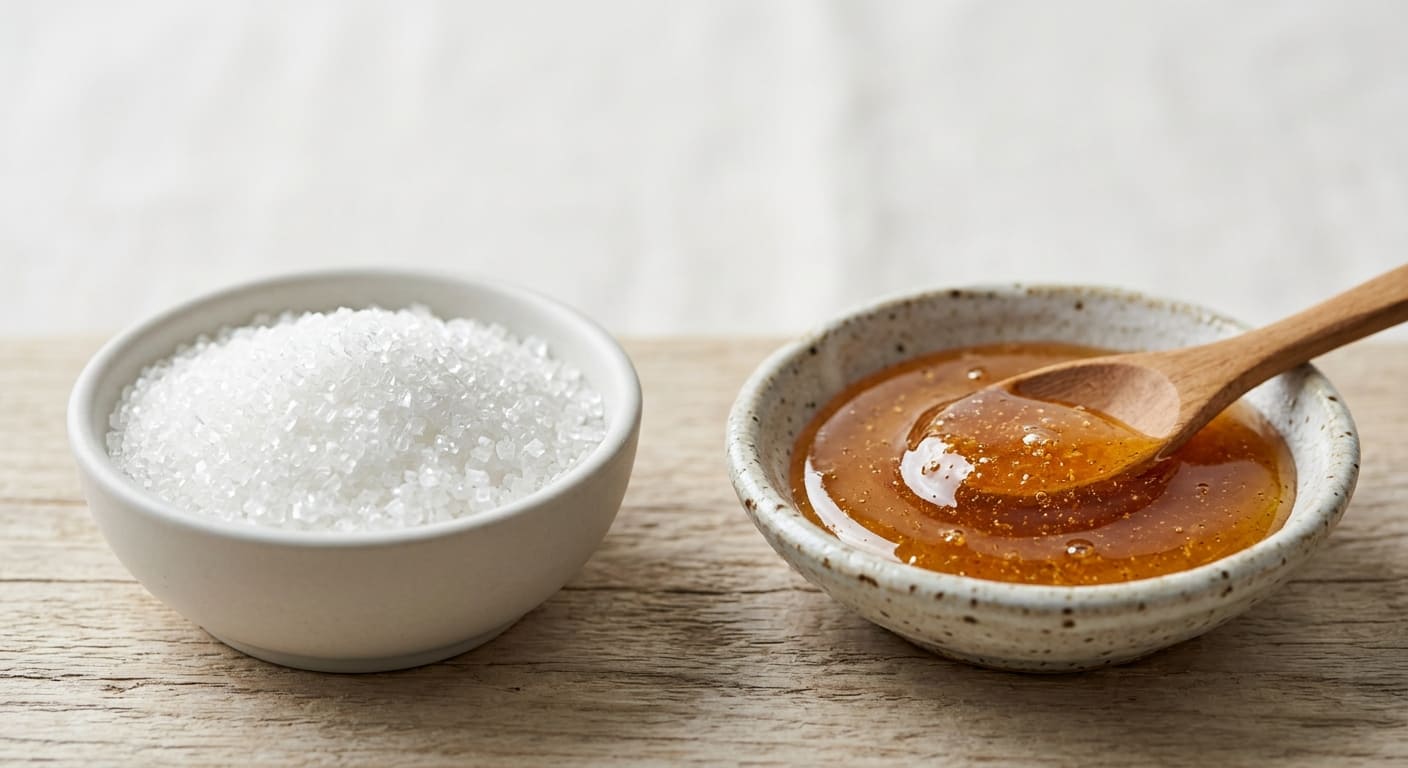
Two sweeteners, one mostly-overlapping chemistry.
White sugar is sucrose — a single, bonded molecule that’s exactly 50% glucose and 50% fructose, refined out of sugar cane or sugar beets until almost nothing else remains. It has no water content to speak of and no measurable micronutrients. It is, structurally, one of the simplest things in your pantry.
Honey is messier, and that messiness is its whole identity. Bees collect nectar, then add an enzyme called invertase that breaks sucrose apart into free-floating fructose and glucose before the hive even finishes ripening it. The result is a syrup that’s typically roughly 38% fructose and 31% glucose, with the rest made up of water — around 17–20% — plus trace amino acids, enzymes, pollen, and minerals so small they barely register on a nutrition label.
Per 100 grams, white sugar provides roughly 387 calories and 99.8 grams of sugar — essentially pure carbohydrate with nothing subtracted. Honey provides about 304 calories and 82.1 grams of sugar per 100 grams — fewer calories by weight, almost entirely because of the water it carries. But because honey is denser and gets measured by the spoon rather than the scale, a tablespoon of honey runs about 64 calories versus 48 for a tablespoon of sugar — the “lower calorie” framing flips depending entirely on how you measure it.
Kay Nutrition, nutrition comparison citing USDA FoodData Central values
The part that surprises people most: fructose is fructose, regardless of which jar it traveled in. The fructose molecules in honey are chemically identical to the fructose molecules in sugar, in high-fructose corn syrup, and in agave. Your liver processes them exactly the same way it always does — it has no way of knowing, and no reason to care, whether a bee was involved.
The Glycemic Gap, Honestly — Real, But Smaller Than the Marketing Implies
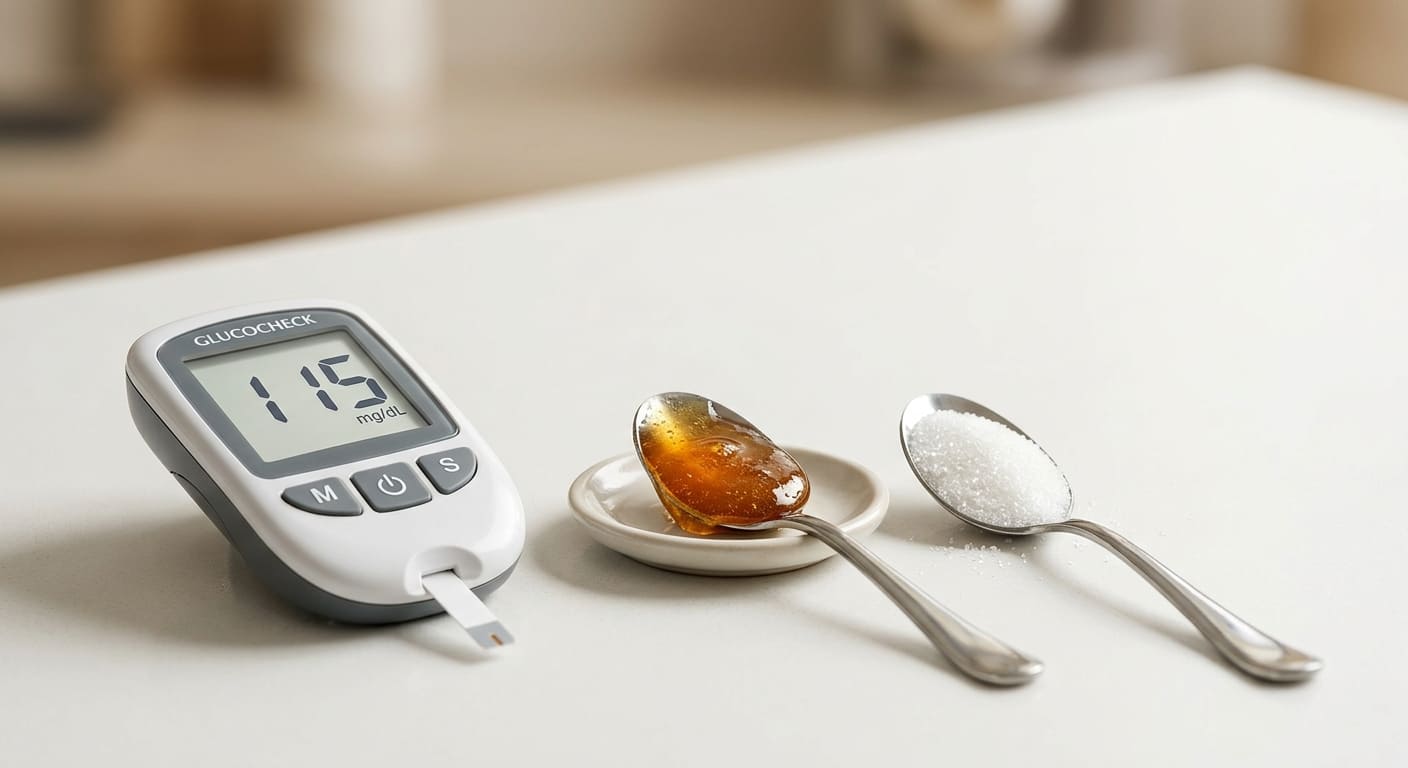
A measurable difference. Not a dramatic one.
The glycemic index measures how fast a food raises blood glucose after eating it, on a scale that tops out around 100. Pure table sugar sits at roughly 65. Honey’s average GI lands lower — most reputable analyses place it somewhere between 55 and 61, though raw, single-floral honeys can range as low as the high 40s depending on their fructose-to-glucose ratio.
That’s a real gap. It’s also a modest one — somewhere in the neighborhood of 7 to 10 points on a 100-point scale, which is a smaller margin than the gap between brown rice and white rice. Honey’s slightly lower GI is mostly explained by its higher proportion of fructose, which has a GI of just 19 on its own and is metabolized through the liver rather than entering the bloodstream as directly as glucose does.
A double-blind randomized trial published in Clinical Nutrition ESPEN gave 60 healthy young adults either 70g of honey or 70g of sucrose daily for six weeks. The honey group saw modest improvements in total cholesterol, triglycerides, and LDL, plus a rise in HDL — the sucrose group moved in the opposite direction on every measure.
But the largest synthesis to date tells a more cautious story. A 2023 systematic review and meta-analysis in Nutrition Reviews, pooling 18 controlled trials, found that honey at a median dose of 40g daily produced small but real improvements in fasting glucose, LDL, and triglycerides versus other sugars — while the researchers explicitly noted that honey is, by every major regulatory definition, still a free sugar, and the effects were modest enough that they shouldn’t be read as license for unlimited intake.
Ahmed A, et al. Nutr Rev. 2023;81(7):758–774. DOI: 10.1093/nutrit/nuac086 · Clinical Nutrition ESPEN, 2018
A 7–10 point GI gap and a small lipid-profile edge in controlled trials are genuine findings. They are not evidence that honey is “blood-sugar friendly” or that it can be eaten without counting it. Both sweeteners will raise your blood glucose meaningfully within the hour. Honey’s curve is slightly gentler — not flat.
What the Regulators Decided — Three Agencies, One Answer
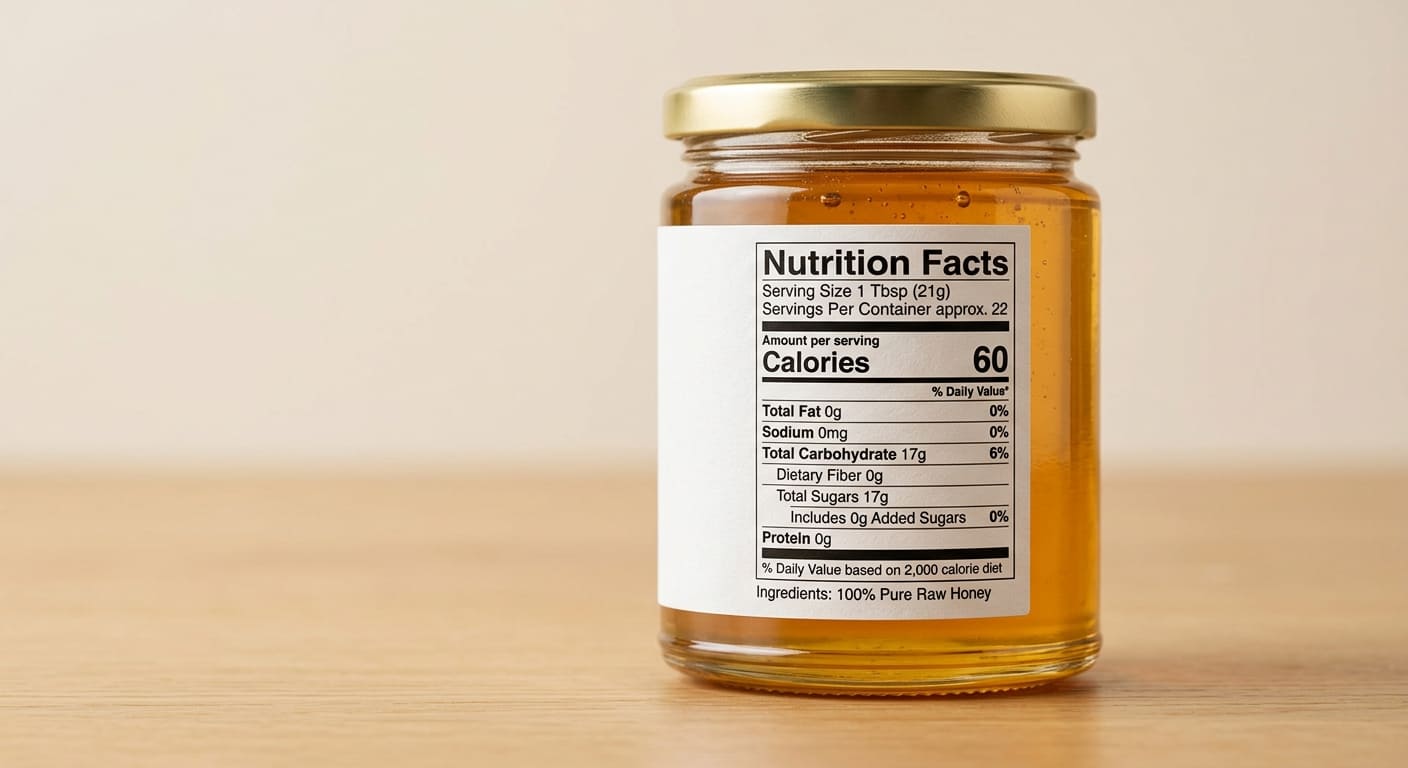
The label rule that quietly settled the debate.
In 2015, the World Health Organization’s sugars guideline defined “free sugars” explicitly to include monosaccharides and disaccharides added to food, plus sugars naturally present in honey, syrups, and fruit juices — then recommended that adults and children keep free sugar intake under 10% of total energy, with additional benefit below 5%. Honey isn’t a footnote in that definition. It’s named in the first sentence of it.
The FDA settled the same question in the United States through a labeling rule, not a press release. In 2019, the agency clarified that single-ingredient products like pure honey and maple syrup don’t have to print a gram count under “Added Sugars” — but they do still have to declare the percent Daily Value for added sugars, because the agency classifies the sugar in honey as added sugar regardless of how it got there.
WHO: Defines free sugars to explicitly include those naturally present in honey, syrups, and fruit juices — recommending under 10% of daily energy, ideally under 5%.
FDA: Requires honey labels to show added-sugar percent Daily Value under its 2019 final guidance, treating honey’s sugars as added sugars by definition.
American Heart Association: Lists honey explicitly alongside high-fructose corn syrup, molasses, and cane sugar as a name added sugars travel under — and caps total added sugar intake at roughly 6 teaspoons (100 calories) daily for most women and 9 teaspoons (150 calories) for most men, with no separate, looser allowance for honey.
WHO Guideline: Sugars Intake for Adults and Children, 2015 · FDA Guidance for Industry, June 2019 · AHA, Added Sugars
Why this matters more than any single study: three independent bodies, working from different evidence bases and different mandates, all landed on the identical classification. That kind of convergence is rare in nutrition science — and it happened precisely because the chemistry isn’t actually ambiguous, even though the marketing around it is.
The Health Halo — Why “Natural” Beats the Nutrition Label, Every Time
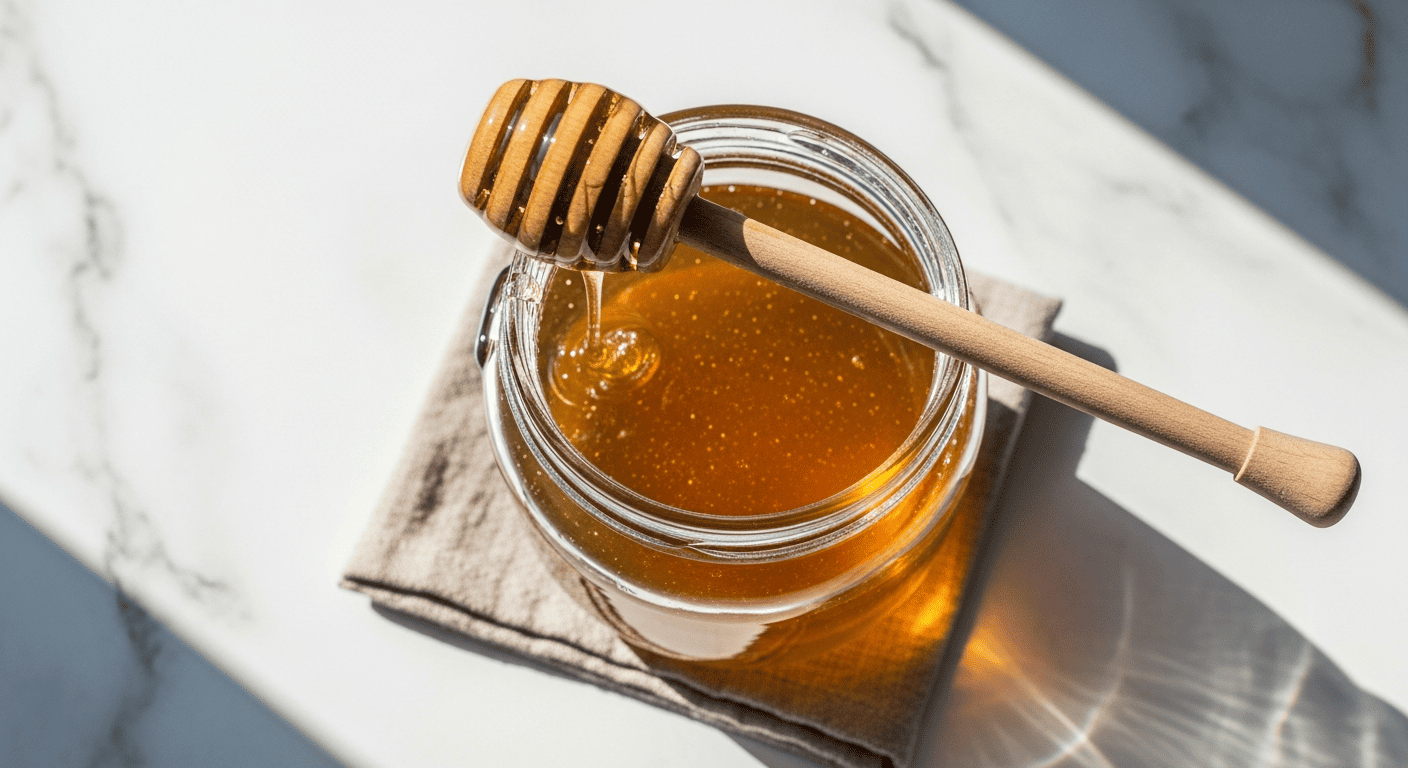
Linen, wood, amber light. None of it is nutrition information — and all of it works.
There’s a well-documented quirk in consumer psychology called the health halo effect: once a product is framed as “natural,” “clean,” or “raw,” people consistently rate it as lower in calories and more nutritious than an identical product without that framing — even when the actual nutrition facts are unchanged or worse. The word does the convincing. The label rarely gets read.
Honey is a near-perfect vehicle for that halo. It comes from bees, not a factory. It’s associated with grandmothers’ tea, sore throats, and folk remedies that predate refined sugar by millennia. None of that imagery is false, exactly — it’s just doing emotional work that has nothing to do with glycemic response. A jar of honey photographed in golden light triggers the same “this is wholesome” reflex as a basket of vegetables, even though, nutritionally, it has far more in common with the white sugar in the cabinet next to it.
The same 2023 Nutrition Reviews meta-analysis notes that the National Honey Board’s own 2020 Consumer Attitudes and Usage Study found honey had surpassed white sugar as consumers’ preferred sweetener — a preference the researchers explicitly contrast with honey’s actual regulatory status as a free sugar. The halo isn’t accidental. It’s measurable, and it’s working exactly as intended.
Wellness marketing has gotten very good at supplying the imagery and letting the audience supply the health claim themselves. No ad has to say “honey reverses inflammation” — it just needs to show the jar next to a yoga mat and a cup of herbal tea, and the brain fills in the rest. Evaluating any “natural sweetener” claim starts with one question worth asking every time: what specifically is this claiming, and does that claim survive being checked against an actual nutrition label?
Honey vs. White Sugar — The Numbers, Per Tablespoon
Stop comparing them by weight — nobody measures honey or sugar on a scale at home. Here’s the side-by-side that matches how you actually use both, per tablespoon.
Values rounded from USDA FoodData Central and the cited nutrition sources above; honey composition varies somewhat by floral source and processing.
Read across that table and the actual story is narrower than either side of the debate wants it to be. Honey is slightly gentler on blood sugar and carries trace antioxidants sugar simply doesn’t have. Sugar is lower in calories per spoon and behaves more predictably in baking. Neither one is a health food, and neither one deserves to be eaten without counting it.
Where Honey Genuinely Earns Its Keep — The Narrow Cases That Are Real

Not a health claim. A flavor and texture claim — and a fair one.
None of this means reach for sugar instead out of spite. Honey has real, non-nutritional advantages that have nothing to do with blood sugar and everything to do with how food actually tastes and behaves.
Choose honey because you like what it does to a cup of tea or a loaf of banana bread. That’s a perfectly good reason. Just don’t choose it because you think it lets you skip the math.
Six Sweeteners, Side by Side
Calories per tablespoon. All are classified as added/free sugars regardless of source.
Note: Every sweetener shown here is classified as an added or free sugar by WHO/FDA standards, including the lower-GI options. GI is not the same as “healthy.”
What the Evidence Actually Supports
Strip out both the wellness marketing and the reflexive “sugar is sugar” dismissal, and four claims survive contact with the research.
5 Honey Claims the Evidence Quietly Corrects
The honey-vs-sugar debate has produced a lot of confident certainty on both sides. These are the five claims most worth checking.
Honey vs. Sugar FAQ
So is honey healthier than white sugar? A little, in a few specific ways that show up in lab values and not much else. It is not a different category of food, and no regulatory body in the world treats it like one. The amber jar and the white bag are closer cousins than either marketing campaign wants you to believe.
Maybe the real lesson isn’t about honey at all. It’s about how easily a warm photograph and the right word — natural, raw, ancient — can stand in for a nutrition label we never actually read. The jar was never the problem. Believing the lighting was the same thing as the evidence — that’s the myth worth retiring.