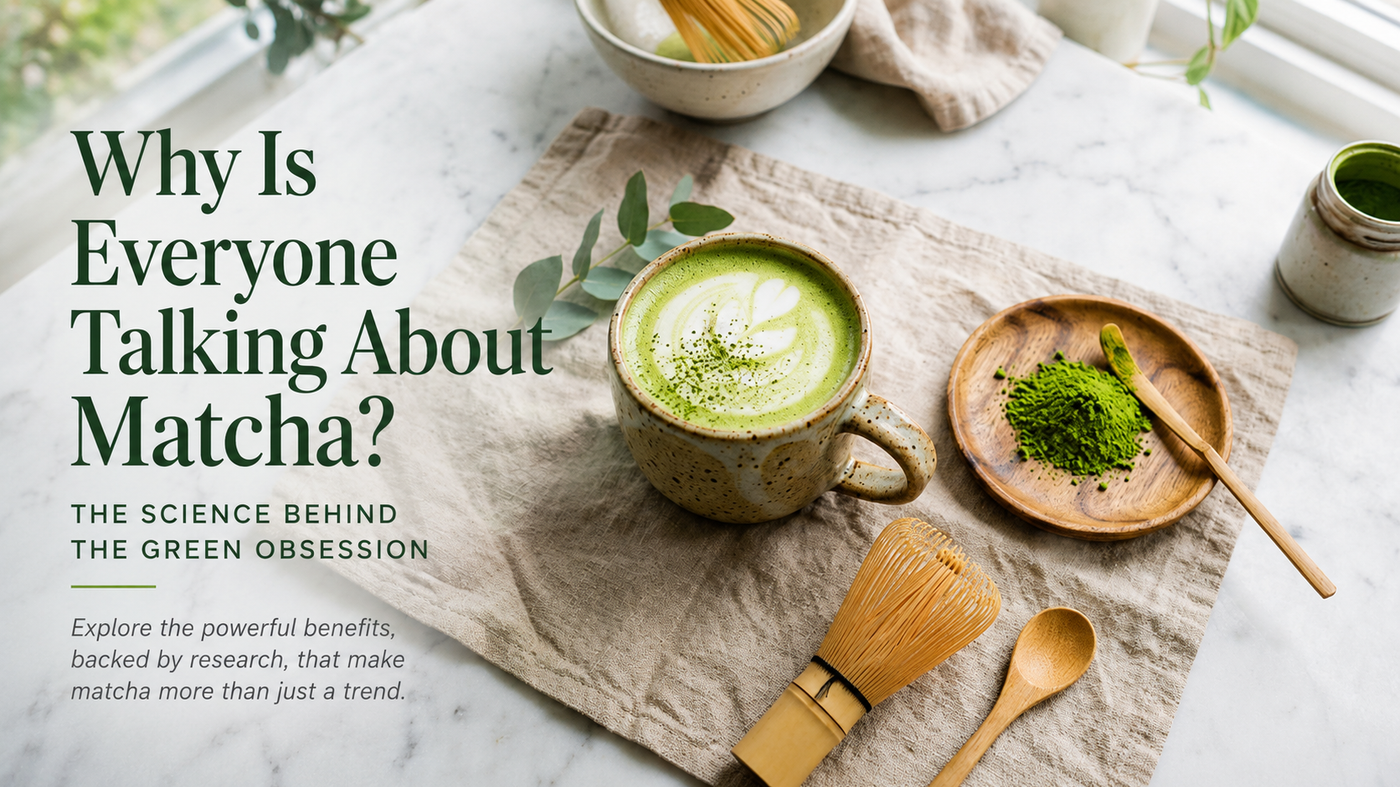
Why Is Everyone Talking About Matcha?
The Science Behind the Green Obsession
A 12th-century monk’s medicine became a $5 billion industry and the internet’s favorite color. Here’s what the research actually says — and what 800 years of ritual understood before any of us.

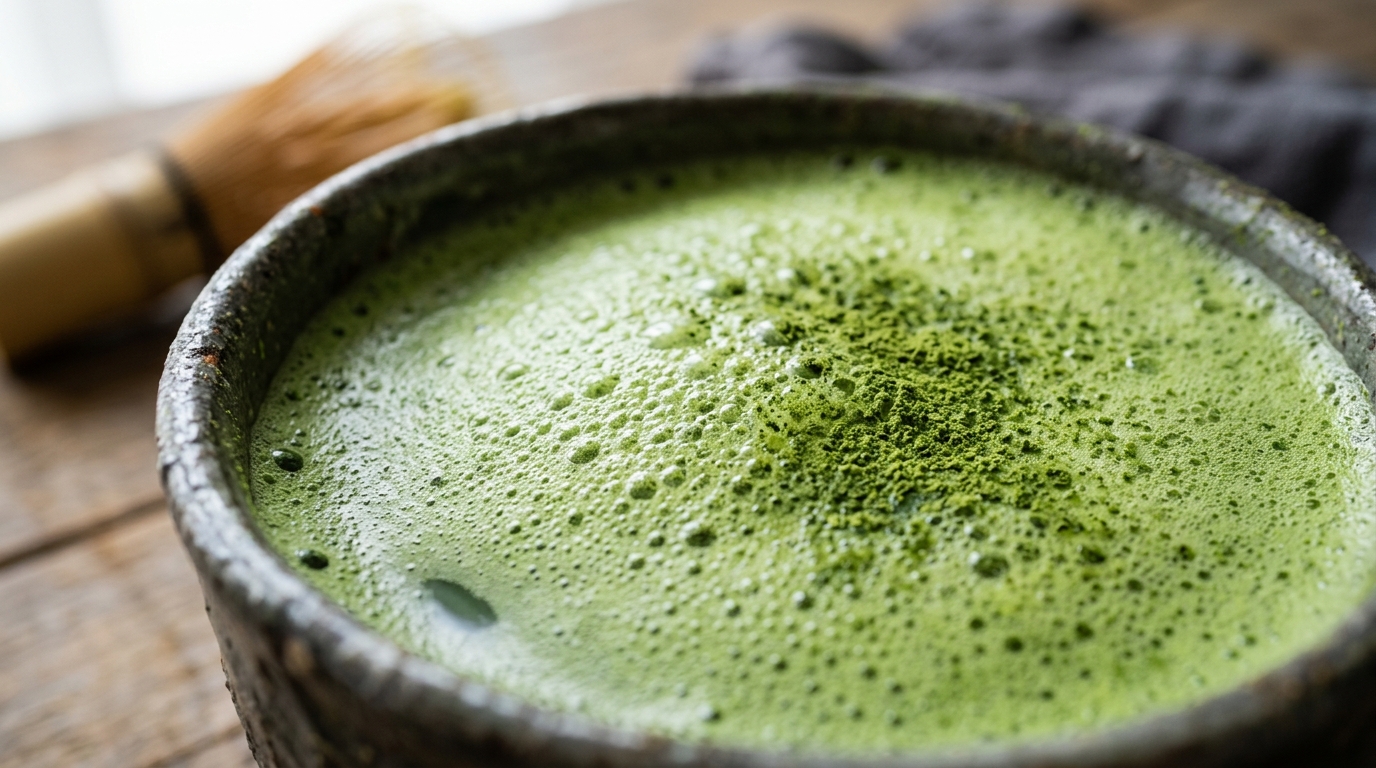
That green is not a filter. It’s chlorophyll, concentrated by design.
Somewhere right now, in Kyoto or Brooklyn or a café you’ve scrolled past on Pinterest, a bamboo whisk is moving through hot water in fast, deliberate strokes. The powder dissolves. The foam rises. The color — that impossible, saturated green — settles into a ceramic bowl that someone will photograph before they drink it.
Matcha is having a moment that refuses to end. It outsells oat milk lattes in some cafés. It has its own aesthetic, its own influencers, its own supply shortage. And underneath the hype sits something genuinely unusual: a drink with real pharmacology, real history, and real data behind it.
This article separates the three forces driving the obsession — the chemistry, the culture, and the aesthetic — with specific studies, honest effect sizes, and a myth-busting section that the matcha marketing industry would prefer you skip.
What Matcha Actually Is — And Why It’s Not Just Powdered Green Tea
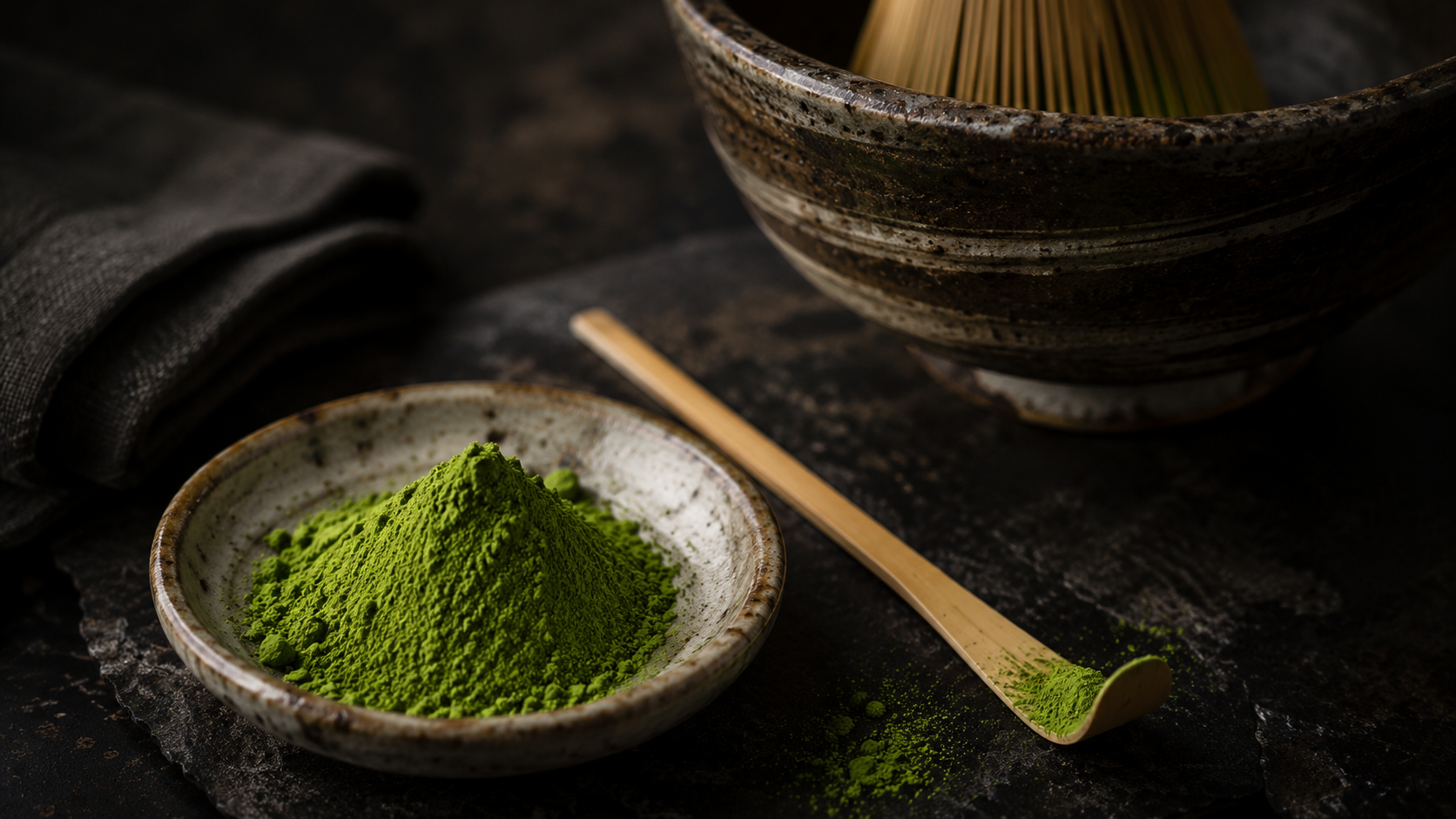
Stone-ground tencha — a single granite mill produces just 30–40 grams of this an hour.
Three to four weeks before harvest, matcha tea plants are covered. Bamboo mats, then tarps — the fields go dark on purpose. Starved of sunlight, the plant panics productively: it floods its leaves with chlorophyll to capture whatever light remains, and it stockpiles L-theanine, the amino acid that would normally convert to bitter catechins in the sun.
The result is tencha — a leaf that is darker green, sweeter, and chemically distinct from anything destined for a teabag. Stems and veins are removed, and the leaf is ground between granite stones so slowly that a single mill produces about 30–40 grams an hour. That patience is not romantic theater. Heat from fast grinding would degrade the very compounds the shading created.
A 2021 review in Molecules (Pomeranian Medical University) confirmed that the shading process measurably elevates theanine, caffeine, chlorophyll, and catechin content — and that because you consume the entire ground leaf rather than a strained infusion, matcha delivers a more concentrated dose of these compounds than steeped green tea. The review names matcha the best condensed dietary source of EGCG, the most studied catechin in nutrition science.
Kochman J, et al. Molecules. 2021;26(1):85. DOI: 10.3390/molecules26010085
The grade system matters more than the price tag suggests. Ceremonial grade comes from the youngest first-harvest leaves and is meant to be whisked with water alone. Culinary grade — slightly more robust, slightly more bitter — is built to survive milk, sugar, and oven temperatures. Neither is a scam; they’re different tools. The scam is the dull, khaki-colored powder sold as “matcha” that was never shaded at all.
The Chemistry of Calm Focus — EGCG, L-Theanine, and Caffeine
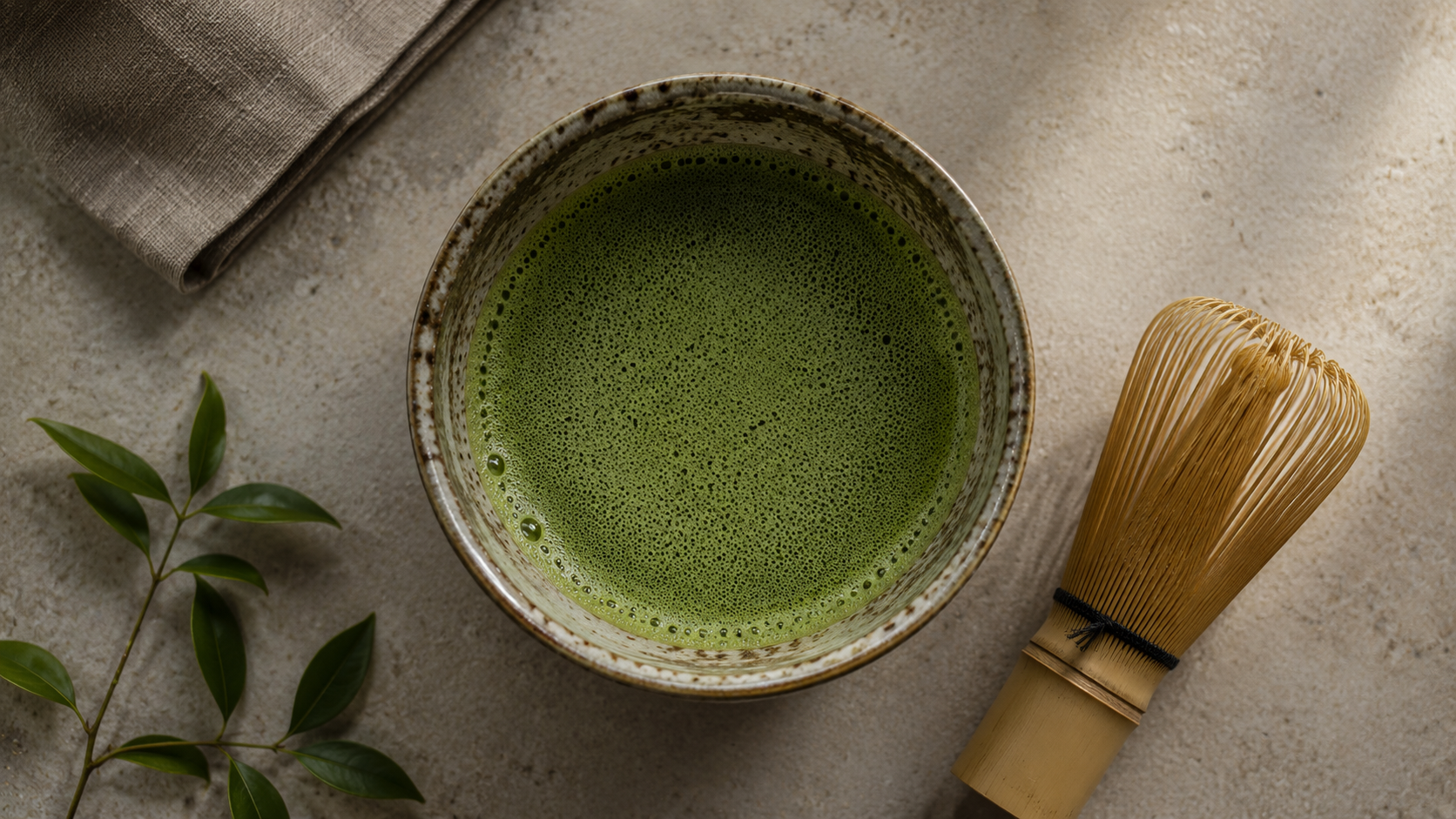
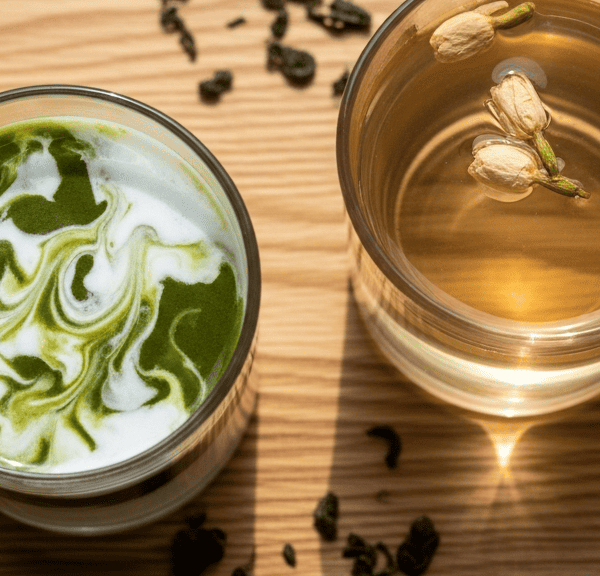
The foam is the proof of the whisk — and the L-theanine underneath is the proof of the shade.
People describe the matcha feeling the same way, almost word for word: awake, but quiet. That consistency isn’t placebo folklore — it maps onto a documented pharmacological interaction between two compounds that almost never travel together in nature at these concentrations.
L-theanine + caffeine: Owen et al. (Nutritional Neuroscience, 2008) compared caffeine alone against caffeine combined with L-theanine in a placebo-controlled trial. The combination improved both speed and accuracy on attention-switching tasks and reduced susceptibility to distraction — effects caffeine alone did not produce.
Matcha itself: Dietz et al. (Food Research International, 2017) tested real matcha — not isolated compounds — in a randomized, placebo-controlled study at Wageningen University. A realistic 4g dose produced measurable improvements in attention speed and psychomotor performance within an hour. The honest caveat: effects were modest, and mood scores didn’t shift. Matcha sharpens; it does not transform.
EGCG: The dominant catechin in matcha, epigallocatechin gallate, activates AMPK — the same cellular energy-sensing pathway central to most modern longevity research — and is the most plausible mechanism behind green tea’s documented cardiovascular associations.
Owen GN, et al. Nutr Neurosci. 2008;11(4):193–198 · Dietz C, et al. Food Res Int. 2017;99:72–83 · Kim HS, et al. Redox Biol. 2014
Why the pairing works: Caffeine blocks adenosine receptors — that’s the alertness. L-theanine crosses the blood-brain barrier and promotes alpha-wave activity, the brain state associated with relaxed, open attention. One compound presses the accelerator; the other steadies the wheel. Coffee delivers only the accelerator.
And the cardiovascular backdrop is hard to argue with. The largest green tea cohort ever run — Kuriyama et al. in JAMA, following 40,530 Japanese adults for 11 years — found those drinking five or more cups daily had a 26% lower cardiovascular death risk and 16% lower all-cause mortality. Matcha wasn’t studied separately, but it is the most concentrated form of the same leaf.
A standard serving is 2 grams of powder — roughly one teaspoon — whisked into 70–80°C water (never boiling; it scorches the theanine sweetness into bitterness). One to two servings a day mirrors the consumption patterns in the population studies. More is not better; it’s just more caffeine.
Matcha vs. Coffee — Why “No Crash” Isn’t Entirely Marketing
Coffee’s caffeine arrives fast and alone — a spike, a peak, and the familiar 2 p.m. descent. Matcha’s caffeine arrives in company. Consuming the whole leaf means the caffeine comes packaged with fiber, catechins, and L-theanine, and users consistently report a flatter, longer arc of alertness. The subjective reports align with what the Owen trial measured: sustained attention without the edge.
It’s also simply less caffeine. A 2g serving carries roughly 40–90mg depending on grade and harvest — versus about 95mg in a standard brewed coffee. For anyone who loves the morning ritual but not the afternoon static, that math is the whole pitch.
(JAMA, 40,530 adults, 11 years)
(Wageningen University RCT)
None of this makes coffee a villain — coffee has its own impressive mortality data. The honest framing: matcha is a different shape of energy. Gentler onset, longer plateau, softer landing. Which one is “better” depends entirely on what your nervous system is asking for at 8 a.m.
800 Years of Ritual — The Culture the Trend Is Standing On
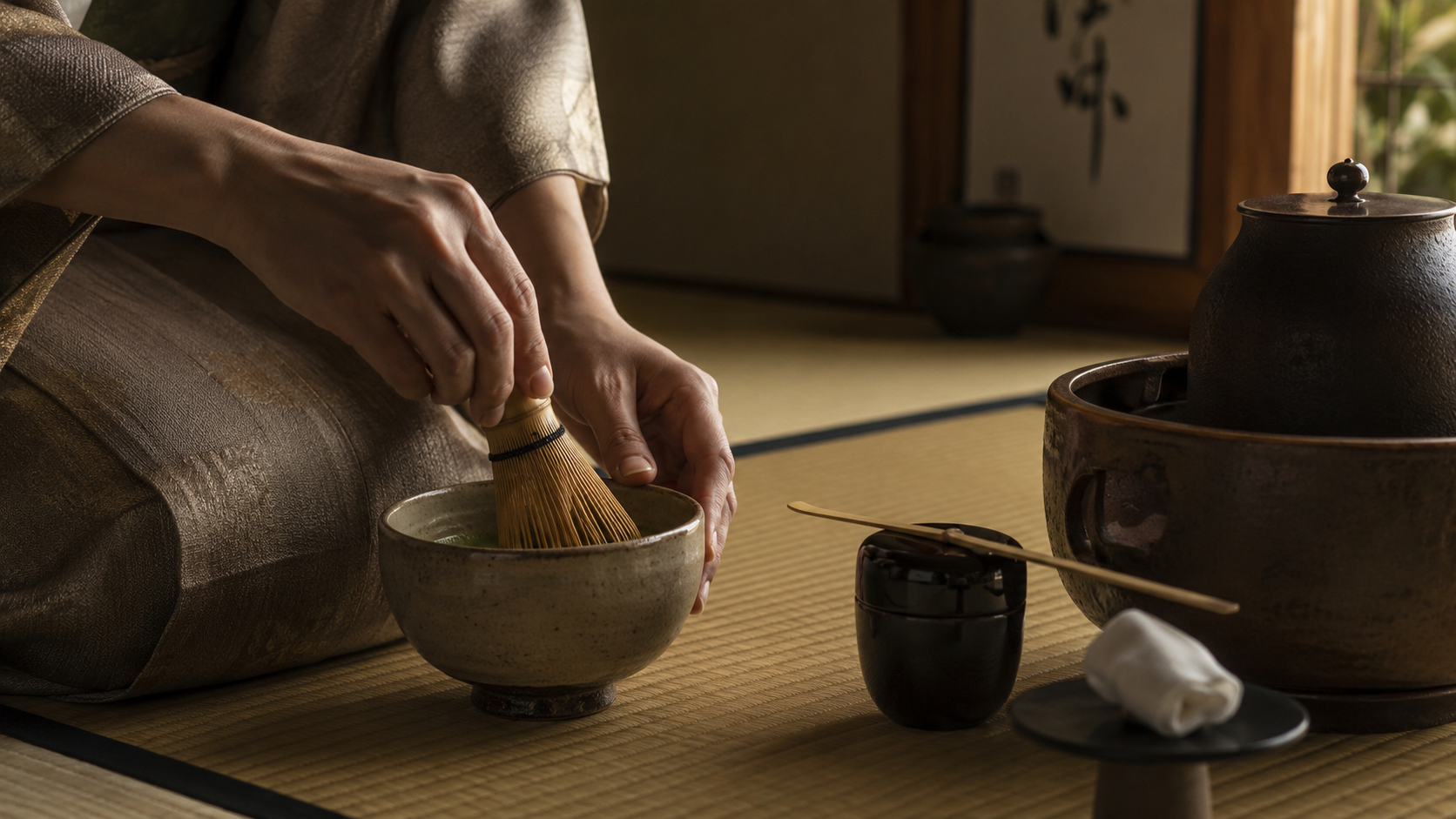
Chanoyu: every gesture, from the angle of the bowl to the sound of the whisk, performed with total attention.
In 1191, the monk Eisai returned from China carrying tea seeds and a conviction: powdered tea was medicine for meditation. Zen monasteries adopted it for exactly the quality modern offices crave — wakefulness without agitation. Over the following four centuries, that monastic habit was refined by tea master Sen no Rikyū into chanoyu, the Japanese tea ceremony: a choreography of hosting in which every gesture, from the angle of the bowl to the sound of the whisk, is performed with total attention.
The ceremony’s animating idea is ichi-go ichi-e — “one time, one meeting.” This gathering, with these people, in this light, will never happen again, so be entirely here for it. It is mindfulness with a 400-year head start, and it shares DNA with the broader Japanese tradition of disciplined, minimalist eating that treated food as practice rather than fuel.
Whisking matcha demands 2–3 minutes of focused, repetitive motion you cannot rush. A 2017 review in Frontiers in Psychology found that low-arousal daily rituals measurably reduce cortisol and perceived stress. Part of what people buy when they buy matcha is an enforced pause — and the pause itself has pharmacology.
This is the part of the story worth keeping honest: the modern matcha latte is a cheerful descendant, not a continuation, of chanoyu. But the borrowed gravity is real. People sense that the whisk and the bowl carry centuries of intention — and in a culture of lids and straws and drinks consumed while walking, three minutes of deliberate preparation feels almost radical.
Why That Green Owns the Internet — The Psychology of the Matcha Moment
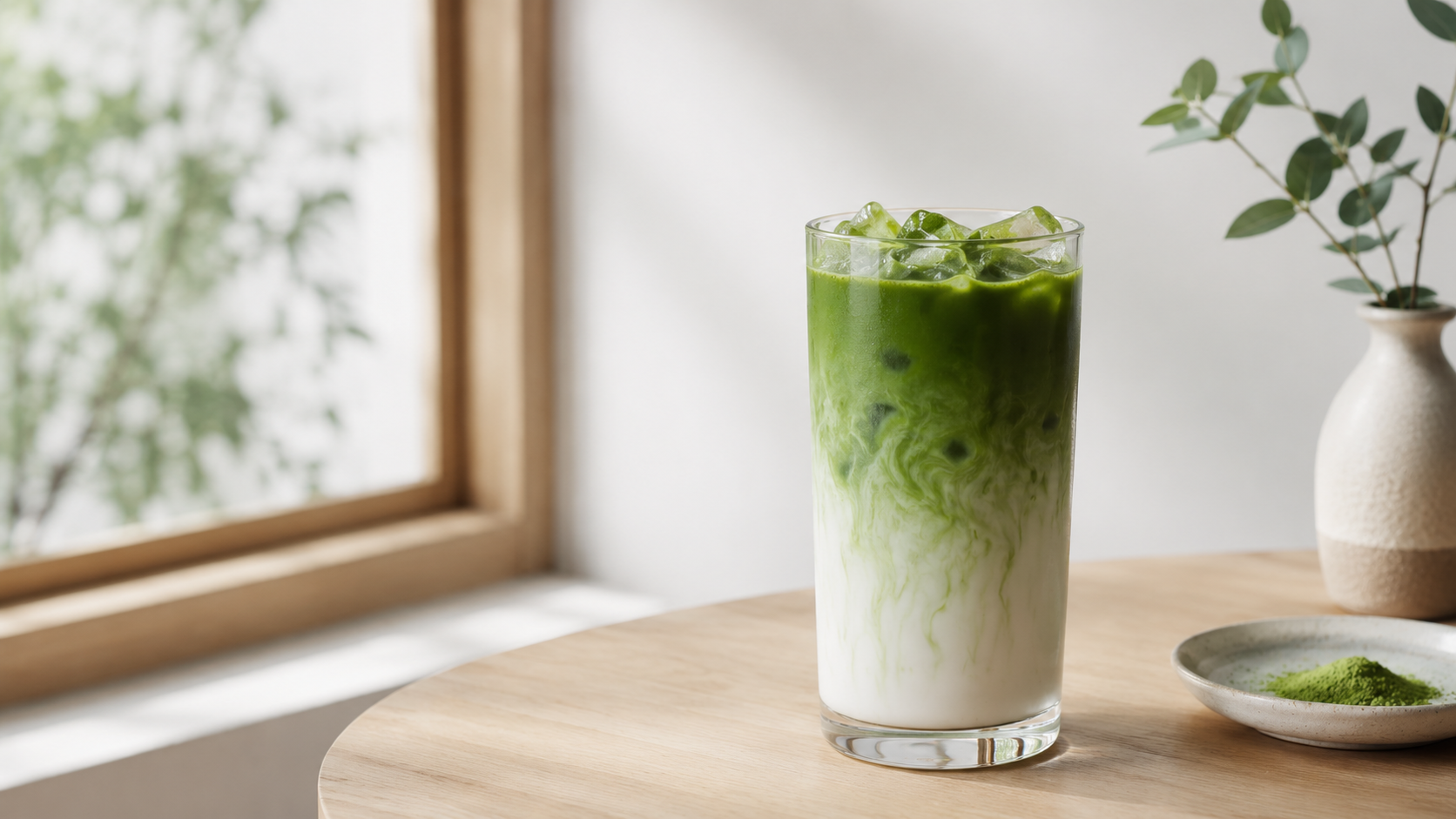
iced matcha latte with distinct green-over-white milk gradient in a tall glass.
Strip away the health claims entirely and matcha would still be winning, because matcha is almost unfairly photogenic. The pour of an iced matcha latte — emerald sinking through white milk in slow marbled clouds — is a two-second video that needs no editing. The whisked foam catches light like velvet. Even the powder, mounded on a black plate, looks like pigment in an artist’s studio.
Color psychology does quiet work here. Green is the color the eye processes most easily; it reads as nature, balance, and safety in essentially every culture. A matcha latte is, visually, a wellness claim before a single word is written — which is precisely why it performs so well in Pinterest’s save-driven economy, where images are bookmarked as aspirations. A matcha photo isn’t just a drink. It’s a portrait of the morning you intend to have.
There’s a deeper layer, too — the same one that makes animated food scenes feel inexplicably comforting. Matcha’s whole visual language — the steam, the ceramic, the unhurried hands — signals care. And images of care are the most saveable images on the internet.
Per Grand View Research, the global matcha market reached an estimated $5.07 billion in 2025 and is projected to hit $8.86 billion by 2033 (7.1% CAGR) — growth driven explicitly by health consciousness and the migration of café culture onto social platforms. A monastery drink is now one of the fastest-growing beverage categories on Earth.
Grand View Research, Matcha Market Analysis & Forecasts 2021–2033
Caffeine Per Serving — Visualized
Typical caffeine content per standard serving. Matcha shown at the midpoint of its 40–90mg range for a 2g serving.
Note: Caffeine varies with grade, harvest, and preparation. Figures are typical midpoints for illustrative comparison only.
What the Evidence Actually Supports
Cut through both the hype and the backlash, and four claims survive contact with the research — the same four that explain why this trend, unlike most, has staying power.
5 Matcha Claims the Evidence Quietly Corrects
The matcha boom has produced wonderful drinks and dubious copy. These are the five claims most worth correcting.
Matcha FAQ
So why is everyone talking about matcha? Because, for once, the internet’s obsession and the evidence point in roughly the same direction. The chemistry is real, if more modest than the labels claim. The culture is real, and far older than the trend borrowing it. And the aesthetic is real in the way all good aesthetics are — a picture of the slower, more deliberate life we keep promising ourselves.
Eight hundred years ago, monks whisked this powder to stay present. We photograph it for the same reason, whether we’d phrase it that way or not. The bowl was never really about the tea. It was about the three minutes you give it — and matcha, stubbornly, still refuses to be rushed.