Why Is Jasmine Tea Replacing Matcha
as the Internet’s Favorite Morning Drink?
Jasmine flowers only open their scent after dark. Somewhere along the way, the internet’s loudest, greenest wellness drink started losing ground to a quieter one that was scented at night — here’s the science, the history, and the aesthetic behind the shift.

Jasmine flowers do something strange for a plant that people photograph so often in daylight: they save themselves for the dark. The buds stay tightly shut all afternoon, then quietly release their scent after sunset, which is exactly why the farmers who turn them into tea have always picked at dusk and let the flowers finish their work overnight, in the dark, next to the leaves.
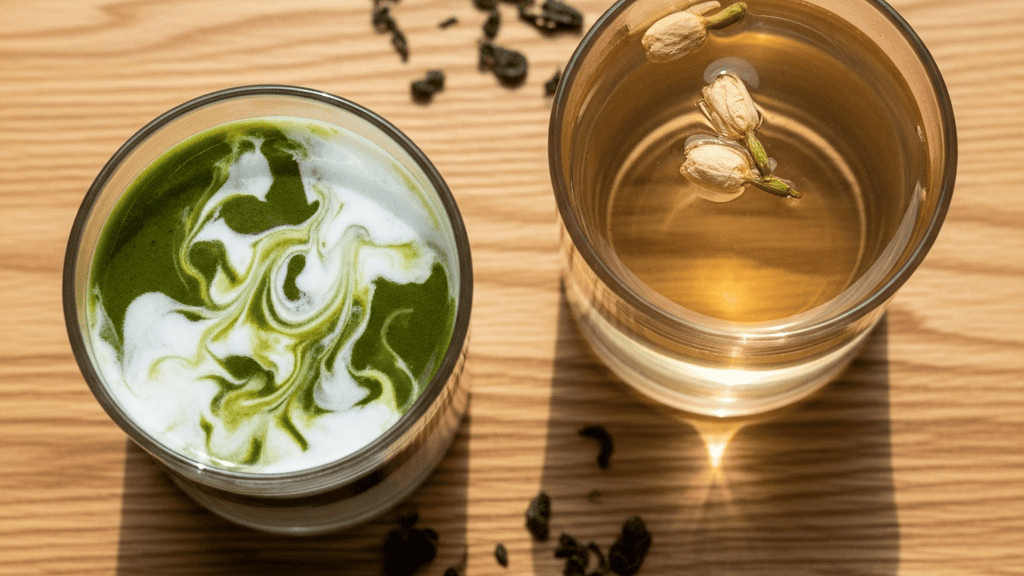
Matcha, for years, has been the loudest drink on the internet — that electric green, that whisk video, that supply shortage. But scroll through food Pinterest boards and café menus right now and something quieter is elbowing in: pale gold liquid in a clear glass, a few real petals still floating in it, captions about “soft mornings” instead of “clean energy.”
This article looks at whether that shift is actually happening, and why — the real chemistry behind jasmine tea’s calming reputation, a thousand years of Chinese scenting tradition matcha never touched, and the honest data on caffeine, aesthetics, and market growth, with a myth-busting section at the end.
What Jasmine Tea Actually Is — And Why It Takes a Week to Make
Unlike matcha, jasmine tea isn’t a single plant. It’s a technique performed on top of an existing tea — almost always green tea, occasionally white or oolong. The process is called xun zhi, or scenting, and it has nothing to do with adding flavoring after the fact.
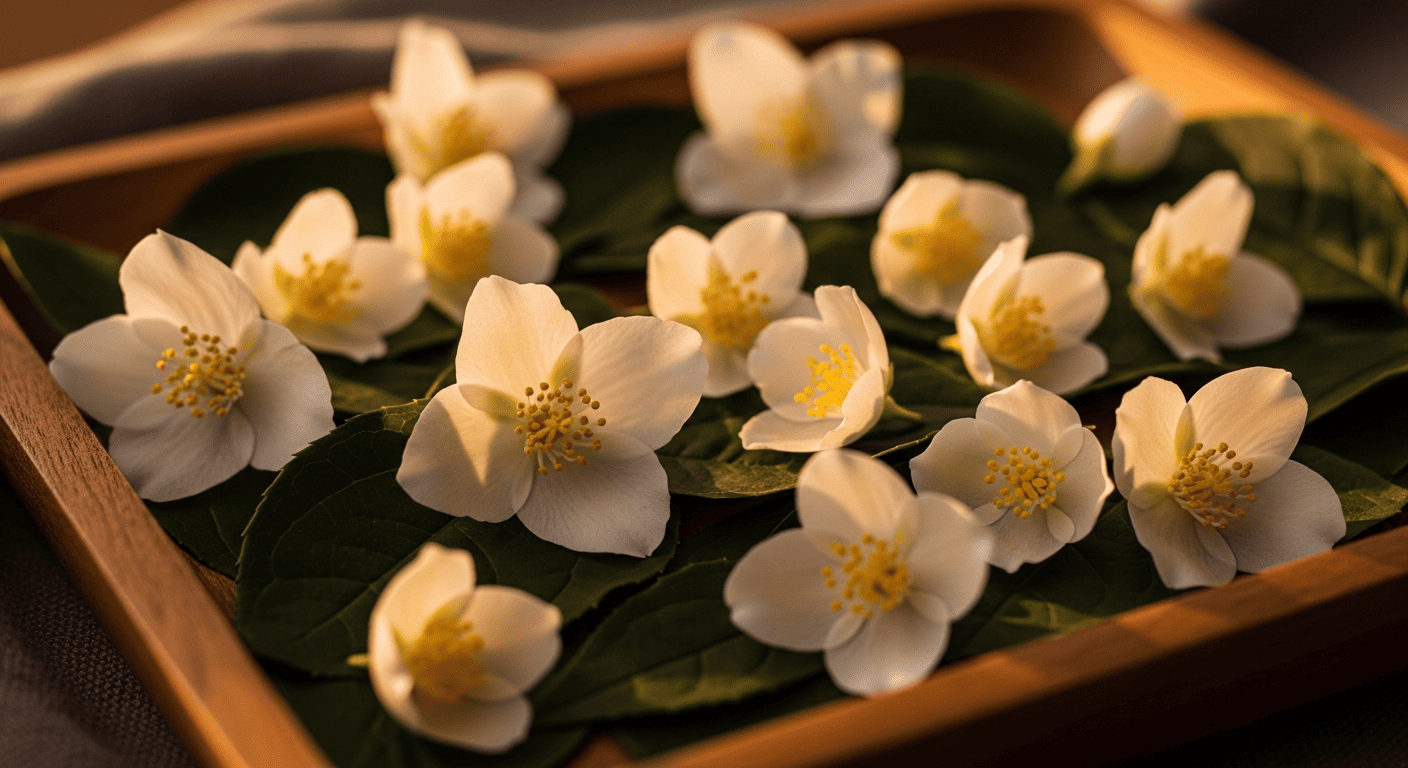
Fresh Jasminum sambac buds are harvested in the late afternoon, just before they’re ready to bloom, then layered directly over dried tea leaves in shallow trays. Overnight, the flowers open and release their aromatic oils, and the tea — which is dry and porous — absorbs them like a sponge. By morning, the spent flowers are sifted out. For low-grade tea, this happens once. For the tea worth paying for, it happens three to seven times in a row, with a fresh batch of blossoms each night.
A 2023 volatilomics study tracking jasmine tea through multiple scenting rounds identified dozens of aroma compounds absorbed from the flowers into the leaf, with methyl anthranilate, linalool, and indole among the most potent contributors to the tea’s signature scent. This is also why the process can’t be rushed or faked with a spray: each additional scenting round changes the leaf’s chemistry, not just its smell.
Volatilomics Analysis of Jasmine Tea during Multiple Rounds of Scenting Processes. Foods. 2023;12(4):812.
The tea base still matters. Jasmine green tea keeps most of green tea’s catechins and a moderate dose of caffeine. Jasmine white tea, made from young, barely processed buds, is gentler on both counts and correspondingly harder to find well made. What almost nobody sells honestly is jasmine tea made without real flowers at all — cheap green tea sprayed with synthetic jasmine essence, which smells close enough on a shelf but flat and one-note in the cup.
The Chemistry of a Slower Calm — Linalool, L-Theanine, and the Nervous System
Matcha’s calm comes from a taste-based interaction: L-theanine and caffeine, both swallowed together. Jasmine tea’s calm partly starts before you’ve swallowed anything — in your nose.
The original finding: Kuroda et al. (2005) exposed volunteers to low-intensity jasmine tea odor and measured a significant drop in heart rate along with increased high-frequency heart-rate variability — a marker of parasympathetic, “rest and digest” activity — plus calmer, more vigorous mood scores. Isolated (R)-(−)-linalool, one of the tea’s aroma compounds, reproduced the same effect on its own.
Clinical relevance: Later work on linalool aromatherapy in surgical patients found measurably lower pre-operative anxiety scores, reduced heart rate and blood pressure, and less need for anti-anxiety medication compared to controls — with effects the researchers described as modest but consistent, generally lasting 30 to 90 minutes per exposure.
The tea itself: A 2025 study found jasmine tea extract improved depression-like behavior in stressed animal models, linking the effect to changes in gut microbiota and brain signaling molecules — early evidence, but consistent with the aroma research.
Kuroda K, et al. Psychophysiology. 2005 · Braden R, et al. 2009, surgical anxiety and linalool aromatherapy · Jasmine tea extract and microbiota-gut-brain axis. ScienceDirect. 2025
Then there’s what’s actually swallowed. Because most jasmine tea is scented green tea, it carries green tea’s L-theanine and catechins, including EGCG — just at lower concentrations than matcha, since you’re steeping and discarding the leaf rather than drinking the whole ground powder. Caffeine follows the same logic: present, but meaningfully lighter.
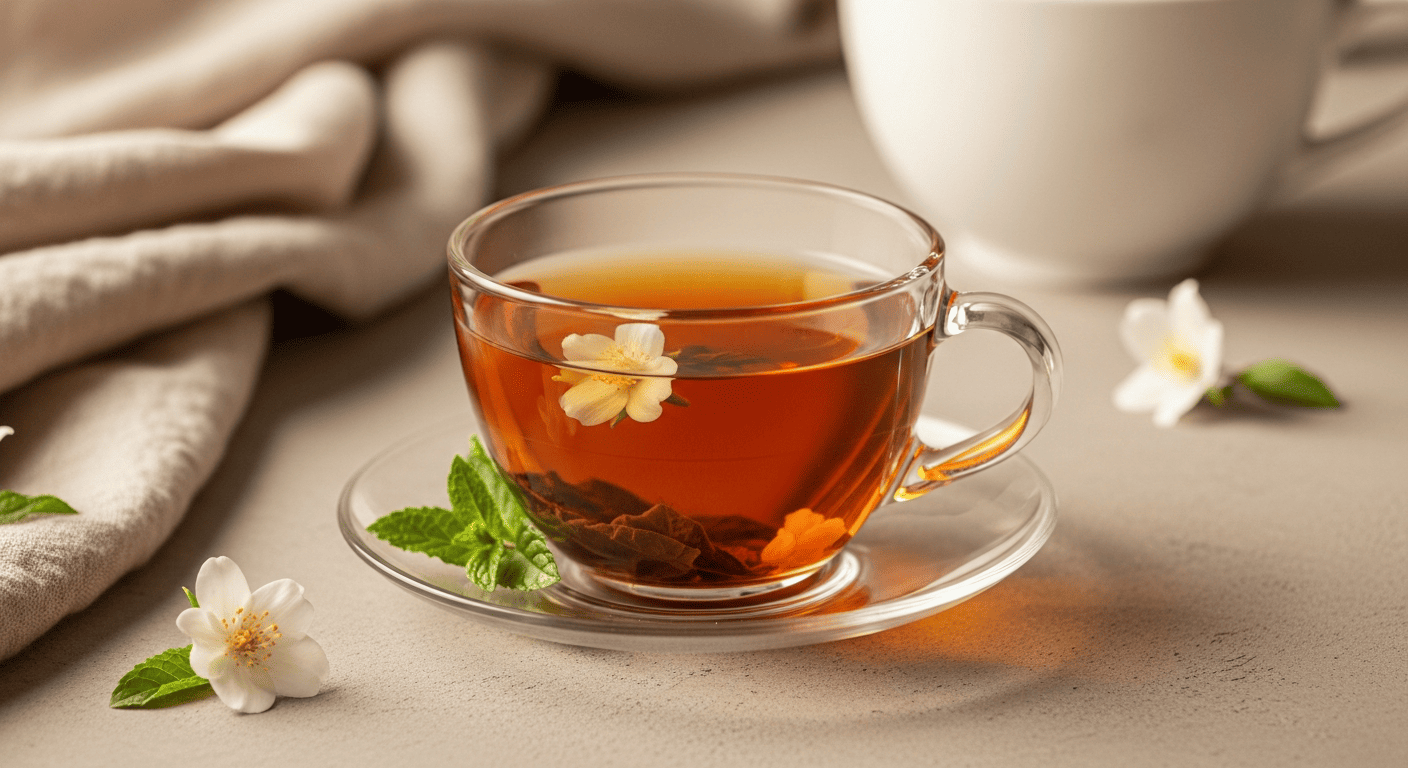
A standard cup of jasmine green tea runs roughly 15–30mg of caffeine, versus 40–90mg for a 2g matcha serving and around 95mg for brewed coffee. Steep at 80°C for 2–3 minutes — boiling water scorches the linalool along with the leaf, flattening the aroma that’s the whole point of drinking it.
Jasmine Tea vs. Matcha — Two Very Different Kinds of Focus
These drinks aren’t really competing on the same axis, which is part of why calling one a “replacement” for the other oversimplifies it. Matcha is a stimulant with a smoothing agent built in — real caffeine, meaningfully softened by L-theanine. Jasmine tea is closer to the opposite approach: a mild stimulant wrapped in an aroma that’s doing active, measurable calming work of its own.
For someone who finds even matcha’s gentler caffeine curve too much — afternoon tea drinkers, people sensitive to stimulants, anyone winding down rather than gearing up — jasmine tea fills a slot matcha structurally can’t.
None of this makes matcha’s momentum fake — the global matcha market is still worth billions and growing every year. But jasmine’s rise is real too, and specialty tea overall is projected to nearly double from roughly $41.9 billion in 2026 to $76.5 billion by 2034. The honest read: jasmine isn’t dethroning matcha so much as absorbing the overflow from people who wanted the ritual without quite that much green, or quite that much caffeine.
1,000 Years of Scenting — The Craft the Trend Doesn’t Mention
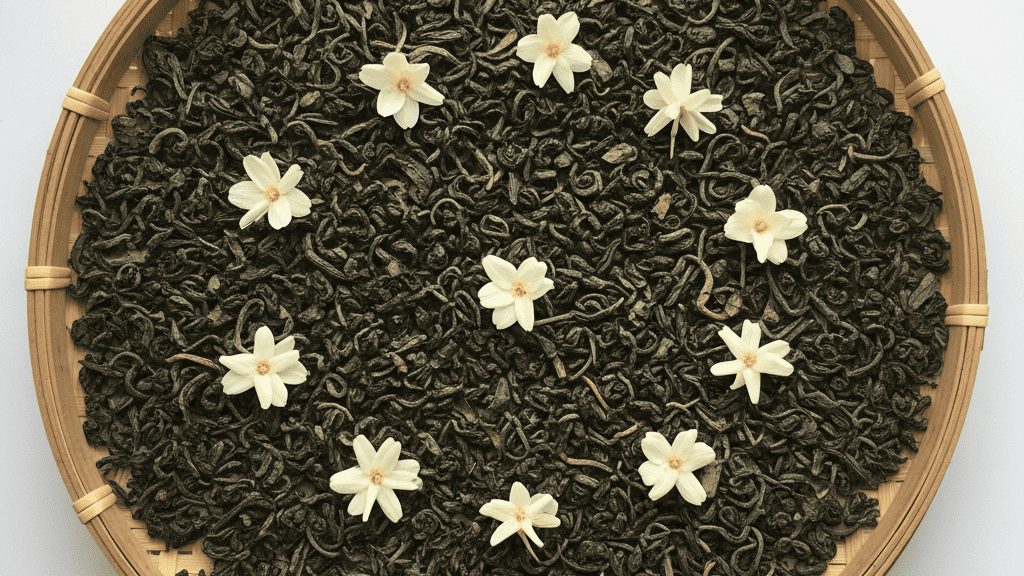
Jasmine reached China from Persia over 2,000 years ago along the Maritime Silk Road, first valued purely as an ornamental and perfume flower in the coastal city of Fuzhou. Somewhere in the Song dynasty (960–1279 AD), someone laid it directly over tea leaves — and the scenting craft was born.
The technique matured through the Ming dynasty and reached full commercial scale under the Qing, when it became a favorite of Empress Dowager Cixi, who reportedly gifted it to foreign envoys as a mark of imperial favor. Fuzhou remains the traditional cradle of the craft, while Hengxian in Guangxi province now supplies more than 80% of China’s fresh jasmine blossoms for scenting. In 2022, the traditional Chinese tea processing techniques that include Fuzhou’s jasmine-scenting method were added to UNESCO’s list of Intangible Cultural Heritage.
Matcha’s tradition runs through Zen monasteries and the discipline of chanoyu — tea as meditation performed in daylight, every gesture precise. Jasmine tea’s tradition runs through nocturnal farm labor and a technique repeated for a full week before a single cup is sold. Different centuries, different countries, different plants — the same underlying idea that the best version of something can’t be rushed.
This is also the part most viral jasmine content skips. A tea this fragrant looks effortless in a cup, but the version worth drinking is the product of a full week of nightly, unhurried labor — which, once you know it, changes what “quiet luxury” even means when applied to a drink.
Why the Internet Traded Green for Gold — The Psychology of the Jasmine Moment

Matcha’s whole visual identity is saturation — the greener, the better, the more it announces itself as a wellness flex. Jasmine tea’s aesthetic is the opposite bet: it photographs as restraint. Pale gold liquid, a bare glass, maybe one visible petal. Nothing about it shouts.
That restraint lines up with a broader shift away from performative wellness — the loud green smoothie, the visible supplement stack — toward what’s often called “quiet luxury”: fewer visual cues doing more of the signaling. A jasmine latte reads as someone who doesn’t need the drink to announce their self-care regimen. Ironically, that’s its own kind of performance, just a quieter one.
There’s crossover happening too, not a clean handoff. Floral notes including jasmine are increasingly showing up folded into matcha itself, as cafés chase the same softness by blending rather than switching. The most likely outcome isn’t jasmine replacing matcha outright — it’s the two drinks trading ingredients until “which one is trending” stops being the right question.
The global specialty tea market — which explicitly tracks matcha, jasmine, and other premium varieties — is valued at an estimated $41.92 billion in 2026 and projected to reach $76.51 billion by 2034, a 7.81% CAGR driven by demand for origin-specific, wellness-positioned tea. China alone holds roughly 11% of that market and remains the largest producer of jasmine tea, with floral and botanical blends flagged by industry forecasters as one of 2026’s fastest-growing flavor directions in both café and retail tea.
Fortune Business Insights, Specialty Tea Market Analysis 2026–2034 · Restobiz, 2026 Tea Flavor Trends Report
Caffeine Per Serving — Visualized
Typical caffeine content per standard 8oz serving. Jasmine green tea shown at the midpoint of its 15–30mg range.
Note: Caffeine varies with tea base, grade, and steep time. Figures are typical midpoints for illustrative comparison only.
What the Evidence Actually Supports
Strip out the “matcha is over” hyperbole, and four claims about jasmine tea hold up against the research.
5 Jasmine Tea Claims the Evidence Quietly Corrects
The jasmine wave has produced beautiful drinks and a fair amount of loose talk. Here’s what’s worth correcting.
Jasmine Tea FAQ
So is jasmine tea actually replacing matcha? Mostly no, and a little bit yes. The market data says both are growing. But the aesthetic has genuinely shifted — from a drink that wanted to be seen to one that wants to be sensed, from daylight green to nightfall gold.
A thousand years before anyone measured heart-rate variability, someone in Fuzhou noticed that jasmine flowers only give up their scent after dark, and built a week-long ritual around waiting for it. The internet just discovered the same patience looks good on camera.