Why Are We Drinking
More Herbal Tea?
The Comfort Drink Replacing Wine O’Clock
A mug replaced the nightcap, the espresso, and the doomscroll. Here’s the real chemistry behind chamomile and tulsi, the psychology driving the swap, and the herbal blends everyone’s actually steeping this July.

Somewhere between 6 and 9pm, a lot of kitchens now sound the same: a kettle clicking off, water settling over dried flowers, a mug warming two hands instead of a wine glass or a can. Nobody planned this collectively. It just kept happening, one evening at a time, until it was a pattern.
Herbal tea used to be the drink your grandmother kept in an unlabeled tin for when you were sick. Now it’s a $4.2 billion global category, chamomile is outselling almost everything else in the aisle, and half of Gen Z says they’re actively trying to drink less alcohol — with tea named, repeatedly, as the thing filling the gap.
This article looks at why, honestly — the real pharmacology behind the calm people report, the psychology of what a warm ritual actually does to a stressed nervous system, which specific blends are having a moment this month, and a myth-busting section for the claims that have outrun the evidence.
The Quiet Swap — What Herbal Tea Is Actually Replacing
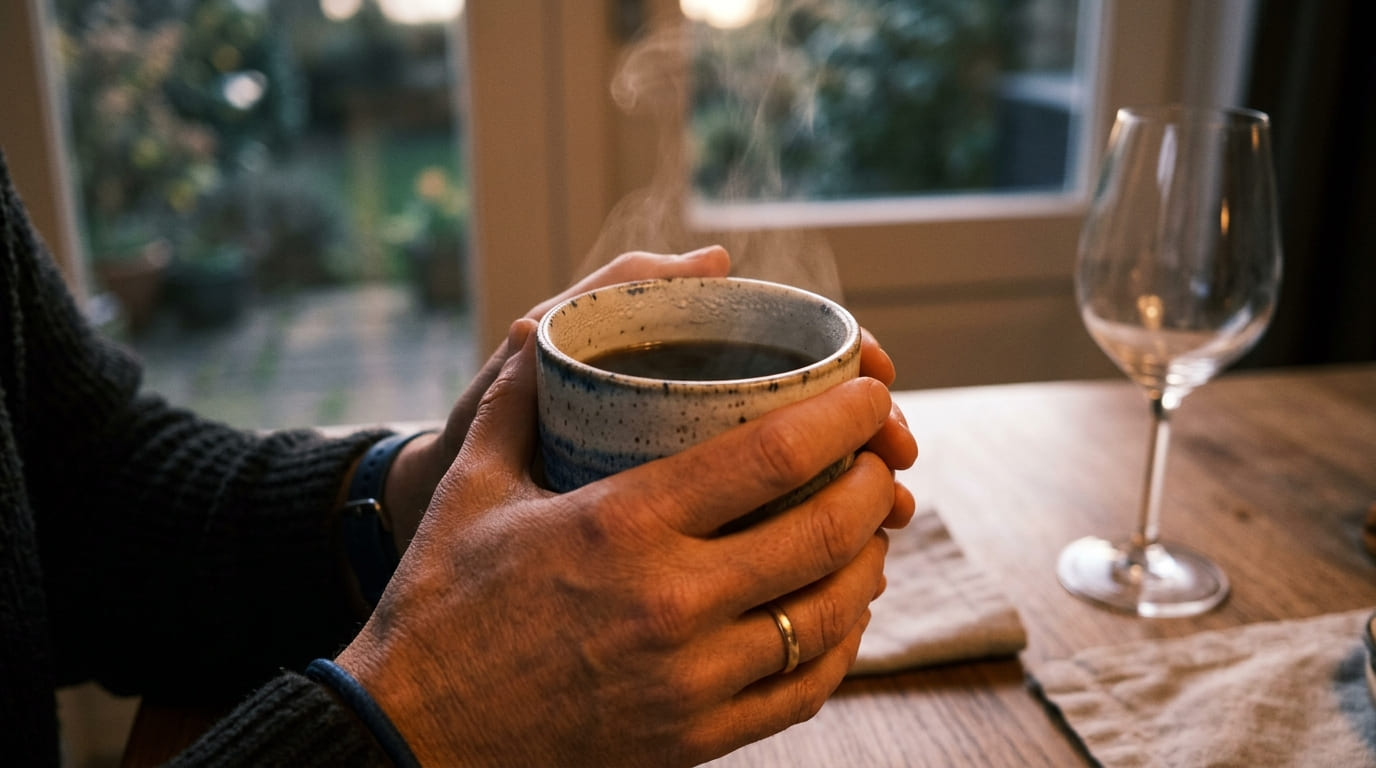
Same hour, different glass. The ritual stayed — the contents changed.
Nearly half of Americans say they’re actively trying to drink less alcohol this year, and interest in “sober curious” living has climbed roughly 44% in just two years. That’s not a fringe wellness trend anymore — it’s a demographic shift, led loudest by Gen Z and reinforced by millennials citing stress management as their main motivation.
Tea keeps showing up as the beneficiary. It offers the part people were actually attached to — a pause, a warm object in the hand, a signal that the workday is over — without the part they’re trying to cut back on. In one German survey, seven in ten regular tea drinkers said they now consider tea a legitimate substitute for an alcoholic drink at the end of the day.
The global herbal tea market is valued at roughly $4.2 billion in 2026, projected to grow at a 3.3% CAGR through the mid-2030s — driven explicitly by consumers choosing caffeine-free botanical infusions for sleep, digestion, and daily stress management. Chamomile alone holds an estimated 32% share of the ingredient category, more than any other single herb.
Future Market Insights, Herbal Tea Market Demand Analysis, 2026–2036
This isn’t only about alcohol. It’s also a quieter rebellion against always-on stimulation — a 9pm cup of something caffeine-free is one of the few moments in a day that isn’t asking anything of you. No screen pairs well with it. No multitasking really works. That friction is starting to look like the point.
The Chemistry of Calm — Chamomile, Lemon Balm, and the Adaptogens
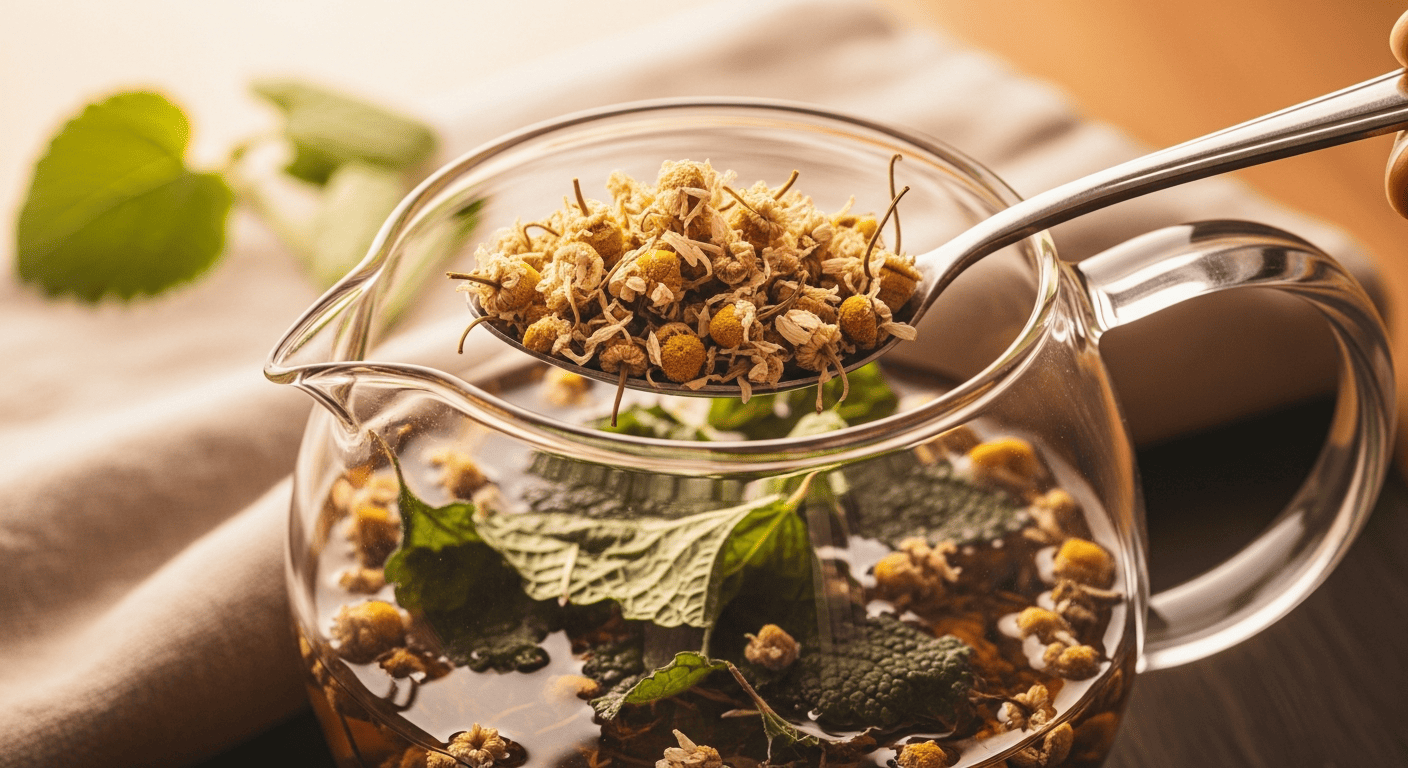
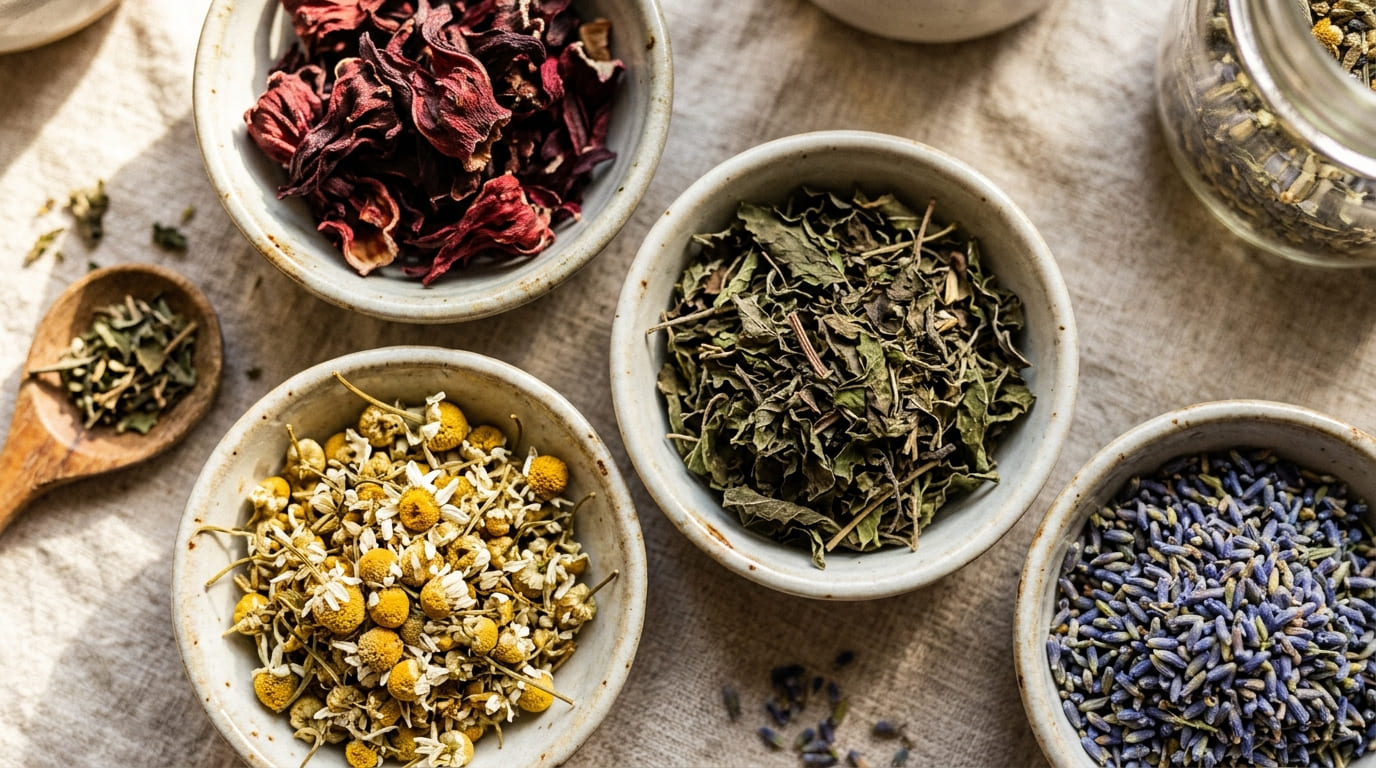
Not folklore — apigenin, an actual GABA-receptor ligand, hiding in a flower.
Herbal tea isn’t one substance, which means it doesn’t have one mechanism — it’s dozens of different plants, each with its own evidence base, and some of that evidence is far stronger than the marketing copy suggests.
Chamomile: A randomized controlled trial published in the Journal of Advanced Nursing found that drinking chamomile tea for two weeks measurably improved sleep quality and reduced depressive symptoms in sleep-disturbed postpartum women. Chamomile’s active compound, apigenin, binds to the same GABA receptors targeted by anti-anxiety medications — which is the most plausible reason it works at all.
Lemon balm: A systematic review and meta-analysis in Phytotherapy Research-adjacent literature pooling multiple clinical trials found lemon balm associated with meaningful reductions in both anxiety and depressive symptoms — one of the more consistently replicated findings among calming herbs.
Tulsi (holy basil): A systematic review in the Journal of Ayurveda and Integrative Medicine found consistent evidence across human trials for tulsi’s adaptogenic, anti-inflammatory, and stress-modulating effects — though the review’s own author disclosed a consulting relationship with a tulsi tea brand, a conflict worth knowing about.
Chang SM & Chen CH, J Adv Nurs. 2016;72:306–315 · Ghazizadeh J, et al., meta-analysis of lemon balm trials · Cohen MM, J Ayurveda Integr Med. 2014;5(4):251–259
The honest caveat: effect sizes are often modest, and not every trial agrees. A 2019 meta-analysis of chamomile for anxiety and insomnia found genuinely mixed results across studies — real signal, but not a guaranteed one, and definitely not an instant one. Herbal tea is a nudge, not a switch.
The ashwagandha studies making headlines for a 27.9% cortisol drop used 300mg of standardized root extract, taken twice daily for 60 days — not a bag steeped for three minutes. A cup of ashwagandha tea is a genuinely pleasant ritual. It is not the same dose as the capsule in the trial, and treating it as equivalent overstates what the cup can do.
What’s Trending This Month — Six Blends Everyone’s Actually Steeping
Scroll through tea shop drops, café menus, and Pinterest boards right now and the same handful of blends keep resurfacing. Here’s what’s actually moving this July — and why each one earned its moment.
Notice the pattern: almost none of these are single-note anymore. The trend isn’t just “herbal tea” — it’s herbal tea doing double duty as a mocktail base, dessert flavor, and skincare-adjacent lifestyle prop, all at once.
The Ritual Effect — Why Steeping Might Matter as Much as Sipping
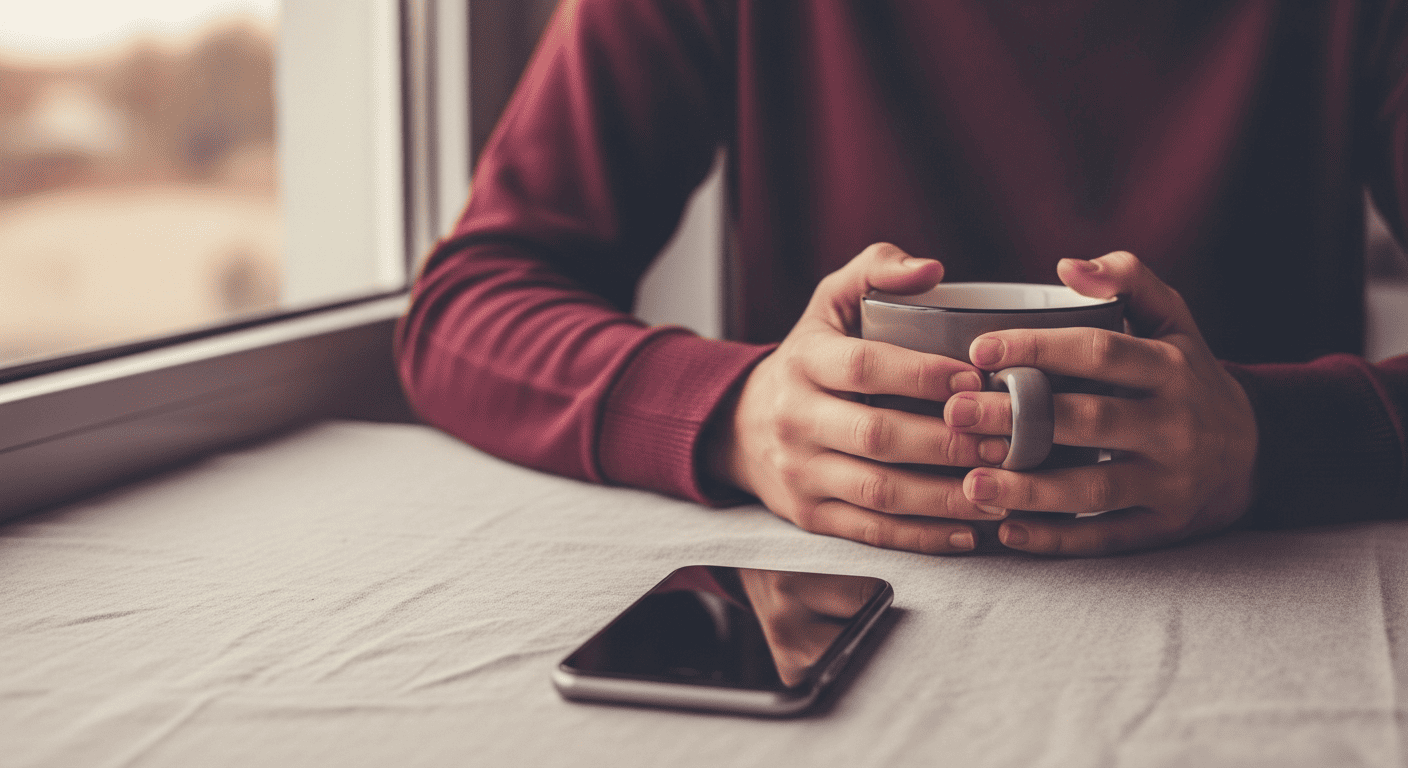
Five minutes with nothing to do but wait for the water to be ready — that’s most of the medicine.
Here’s a detail that rarely makes it into the marketing: several herbal tea trials couldn’t fully separate the effect of the herb from the effect of the ritual around it. Boiling water. Waiting. Sitting still for the steep time. That structure is doing real, measurable work on its own.
A randomized, double-blind, placebo-controlled trial from Tufts University’s USDA Human Nutrition Research Center on Aging had prehypertensive and mildly hypertensive adults drink three cups of hibiscus tea daily for six weeks. Systolic blood pressure dropped by roughly 7.2 mm Hg compared to placebo — and among those with the highest starting readings, the effect nearly doubled.
McKay DL, et al. J Nutr. 2010;140(2):298–303.
(Tufts University RCT)
(NCSolutions consumer data)
None of this means the herb doesn’t matter — the hibiscus number above came from a real controlled trial against a genuine placebo beverage, not the ritual alone. But it does mean the pause you’re building into your evening is not a placebo footnote. It’s a legitimate part of what you’re buying with every cup.
Why It’s Suddenly Everywhere — The Psychology of the Herbal Tea Moment
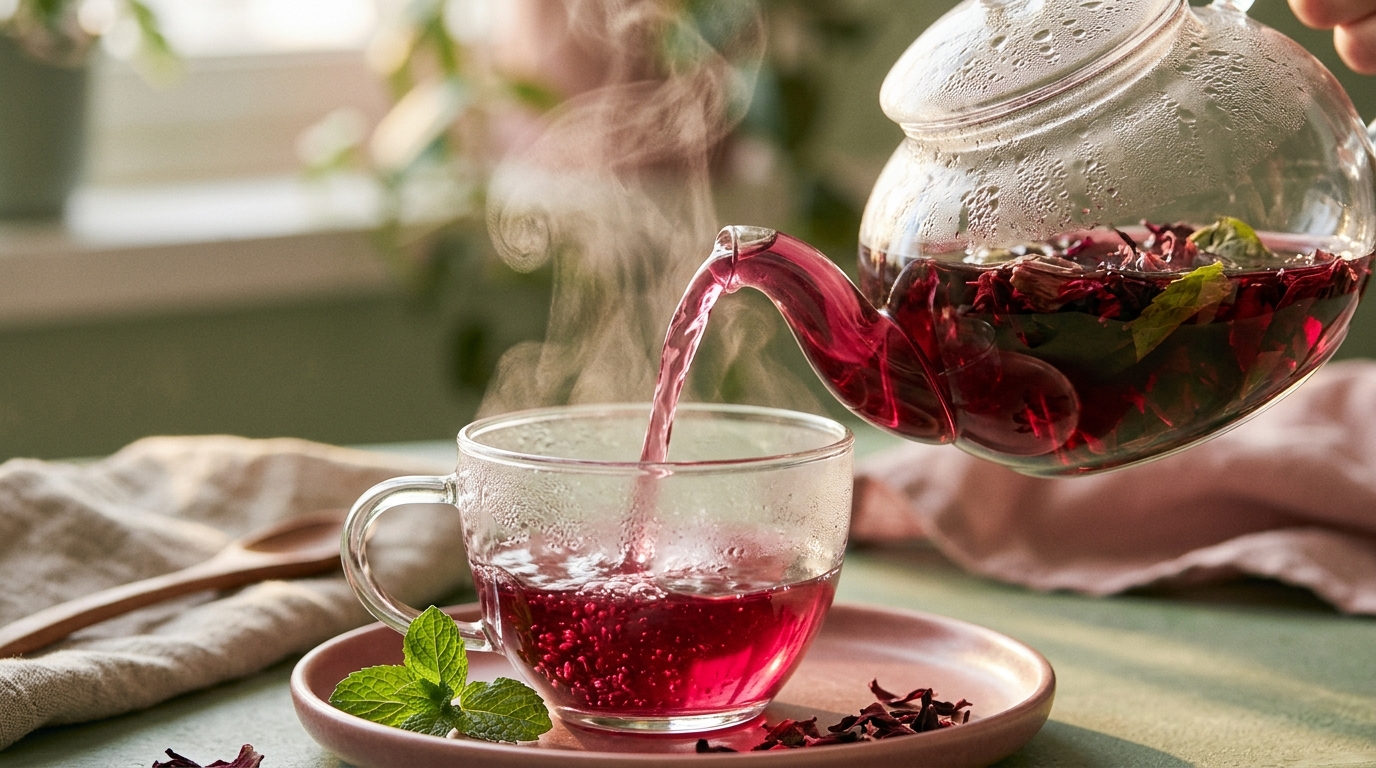
A drink that doesn’t need a caption to explain why it’s calming.
Herbal tea photographs like a mood, not a beverage. Hibiscus pours the color of a sunset. Chamomile settles into a pale honey gold. Lavender-and-chamomile blends read as a color palette before they read as a drink — and that palette happens to match the muted, botanical, “cottagecore-adjacent” aesthetic that’s dominated Pinterest for several years running.
There’s also a quieter status signal at work. A wine glass says you’re celebrating or unwinding in a specific, socially loaded way. A steaming mug of dried flowers says something gentler — I’m taking care of myself — without saying much at all. That restraint is exactly why it saves so well: nobody scrolls past a picture like that feeling judged.
It also plugs cleanly into everything the site has already been tracking in premium tea — the same slow-morning instinct behind jasmine tea’s rise as matcha’s quieter counterpart, just moved to the evening slot instead of the morning one.
Gen Z consumers show the highest engagement with tea during social occasions specifically, and are the demographic most likely to question whether alcohol is actually enhancing the experience it’s supposedly part of. Industry researchers now describe tea’s evolving role explicitly in those terms: not a fallback, but a beverage actively expanding into moments alcohol used to own.
Datassential, Non-Alcoholic Beverage Trends 2026
Which Herbs Actually Dominate the Market
Estimated share of the global herbal tea ingredient category, 2026.
Note: Figures are category-level estimates. Adaptogen blends are the smallest slice today but reportedly the fastest-growing segment.
What the Evidence Actually Supports
Strip out the wellness-marketing overreach, and four claims about the herbal tea boom hold up against the research.
5 Herbal Tea Claims the Evidence Quietly Corrects
The herbal tea boom has produced genuinely useful rituals and a fair amount of overreach. Here’s what’s worth correcting.
Herbal Tea FAQ
So why are we drinking more herbal tea? Partly the plants, partly the pause, and partly the fact that a generation raised on constant stimulation is quietly building small pockets of the day where nothing is required of them except waiting for water to be ready. The chemistry is real, if gentler than the marketing suggests. The ritual is doing more work than anyone gives it credit for.
A dried flower steeped in hot water was never going to solve stress, sleep, or a culture of overwork on its own. But it turns out that stopping for five minutes, on purpose, most nights of the week — that part was never really about the tea either. The mug just gives you somewhere to put your hands while you do it.