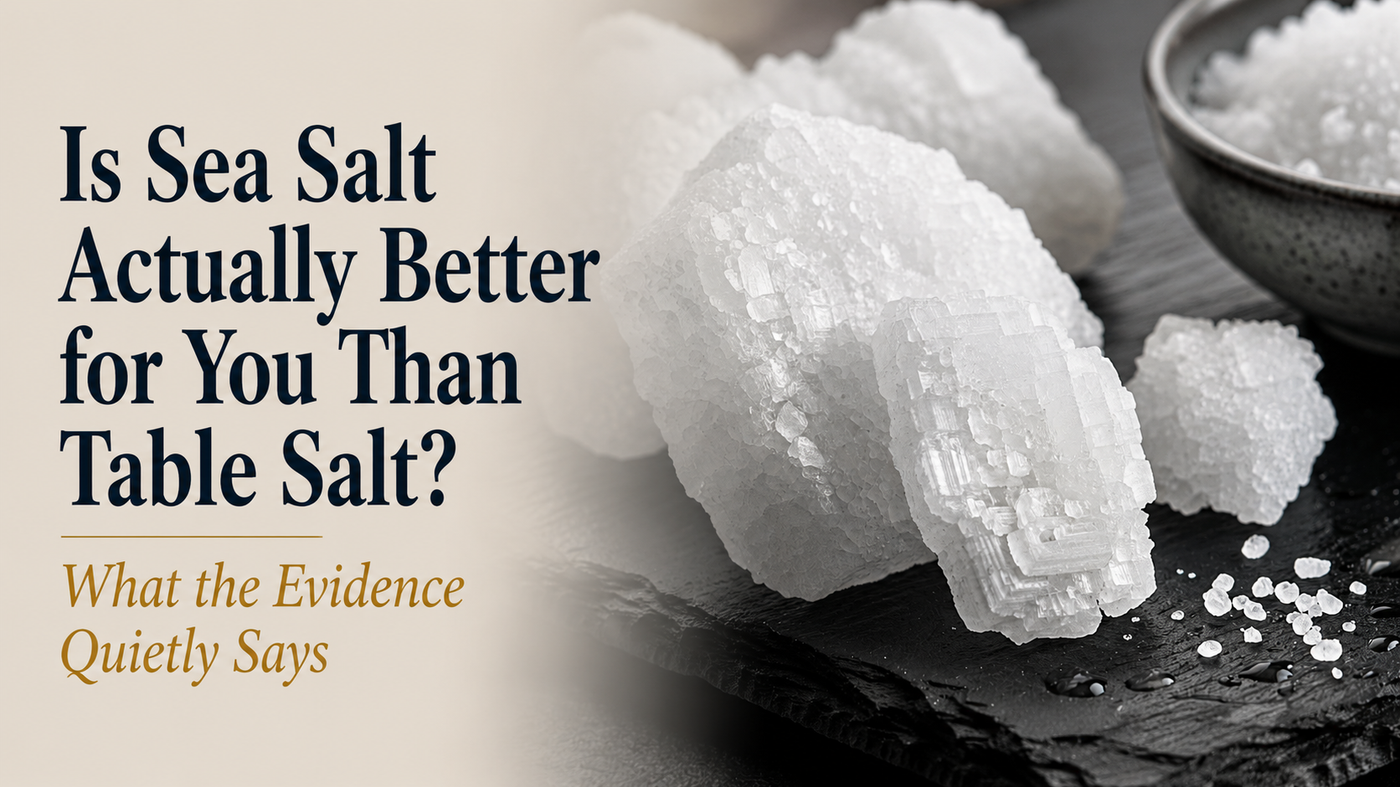
Is Sea Salt Actually Better for You Than Table Salt?
What the Evidence Quietly Says
One costs five times more and comes wrapped in words like natural and pure. The other has quietly protected your thyroid since 1924. The healthier choice isn’t the one the marketing points at — and the difference that matters isn’t sodium.

Pick up two jars in any grocery aisle. One is plain white, cheap, and shaped like every saltshaker from your childhood. The other has a kraft-paper label, a coastal name, flaky crystals you can see, and a price that makes you pause. Somewhere along the way, the expensive one started feeling like the responsible choice.
Here’s the part the packaging never mentions: by weight, the two are almost the same compound. Sodium chloride, give or take a rounding error. The ocean did not make it gentler on your heart.
But “they’re basically identical” isn’t the whole story either — because there is one real nutritional difference between them, and most people have it backwards. This article walks through what’s actually in the jar, what the sodium numbers really say, the mineral you quietly stop getting, and a microplastic twist that complicates the word natural entirely.
What’s Actually in the Jar — Mined Rock vs. Evaporated Ocean

Evaporation ponds: sun and wind doing the work the saltshaker forgets.
Sea salt is made the way it sounds — seawater (or water from a salt lake) is channelled into shallow ponds and left to the sun and wind. As the water evaporates, the salt left behind is barely processed, so it keeps trace amounts of minerals like calcium, potassium, and magnesium, and its crystals stay larger and crunchier than table salt’s. Those minerals are what give a good finishing salt its faint color and its character.
Table salt takes the opposite route. It’s typically mined from underground deposits, then processed to strip out the other minerals, ground to a fine uniform grain, and usually fortified with iodine — which matters for thyroid health. An anti-caking agent goes in so it pours freely on humid days.
Two completely different origin stories. And yet they converge on nearly the same destination: both jars are roughly 97–99% sodium chloride. The romance is in the processing. The chemistry is almost a tie.
Mayo Clinic puts it bluntly: sea salt is often promoted as healthier, but sea salt and table salt have the same basic nutritional value and comparable amounts of sodium by weight. The differences are taste, texture, and processing — not nutrition.
Mayo Clinic Staff · “Sea salt vs. table salt: What’s the difference?” · reviewed 2023
So if the nutrition is a wash, why does the expensive jar feel virtuous? That feeling is doing a lot of work — and the next section is where it falls apart.
The Sodium Myth — Why the Spoon Lies and the Scale Tells the Truth
The single most repeated belief about sea salt is that it contains less sodium. It’s a comforting idea. It’s also wrong in the way that matters most.
By weight, the sodium content of sea salt and table salt is identical — about 40%. Gram for gram, your body cannot tell them apart. The confusion comes from the spoon, not the salt.
Here’s the mechanism nobody explains on the label: sea salt crystals are larger, so fewer of them fit into a teaspoon. Less salt fits in the same volume — which is exactly why people assume sea salt has less sodium. Scoop a teaspoon of flaky sea salt and a teaspoon of fine table salt, and the flaky one really does carry fewer milligrams. Weigh those same two spoonfuls, though, and the illusion vanishes. You were measuring air between crystals.
(Mayo Clinic Health System)
(AHA survey, via Univ. of Illinois Extension)
Nutrition educators at the University of Illinois Extension note that in one American Heart Association survey, 61% of respondents thought sea salt was a lower-sodium alternative — when in fact both contain roughly 40% sodium, and sea salt only appears lighter because its larger grains mean less fits by volume. The American Heart Association’s guidance lands in the same place: for your heart, it’s total sodium intake that matters, regardless of which salt it came from.
American Heart Association · University of Illinois Extension, 2024
For context: U.S. dietary guidelines cap sodium at about 2,300 mg a day — roughly one level teaspoon of table salt. Most of us blow past that long before dinner, and the salt aisle isn’t where it happens. So if your goal is your blood pressure, switching jars is a rounding error. Switching habits is the lever.
The Iodine You’re Quietly Losing — A 100-Year-Old Public Health Win, Slipping
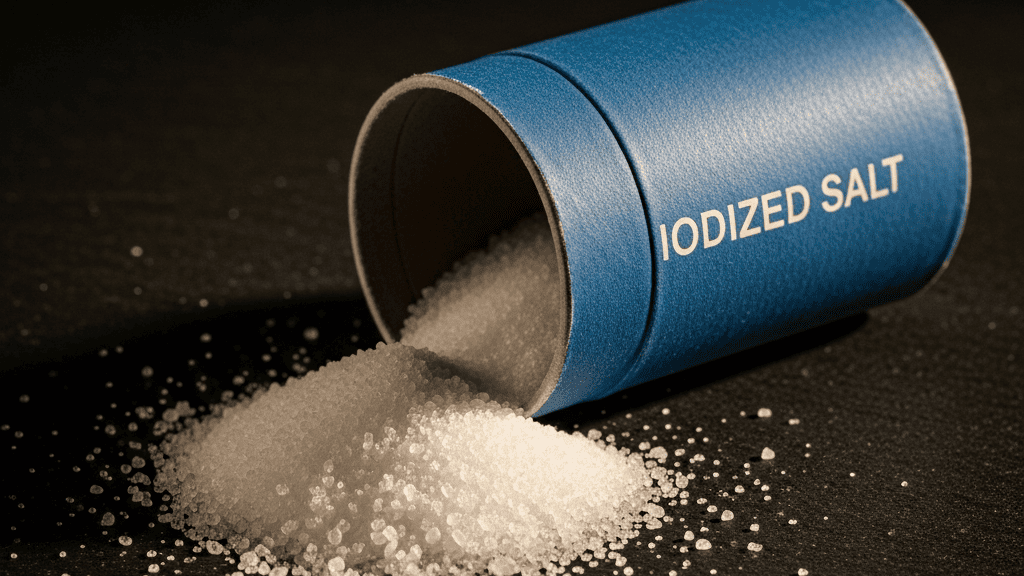
That little word “iodized” did more for public health than almost any seasoning in history.
Here’s where the story finally turns, and where the trend may have quietly cost us something. Your thyroid needs iodine to make the hormones that run your metabolism, your growth, and — before birth and in early childhood — your brain development. Your body can’t manufacture it. It has to come from food.
A century ago, iodine deficiency was so common in parts of the U.S. that whole regions were nicknamed the “goiter belt.” The fix, introduced in 1924, was almost absurdly elegant: add a trace of iodine to the one seasoning nearly everyone used. Table salt has been fortified with iodine for decades, dramatically reducing iodine deficiency and goiter — but most sea salts are not iodized.
Read that again. The trendy “natural” salt skips the one genuinely health-protective thing the boring white salt does.
Endocrinologists at Brown University describe a genuine resurgence of iodine deficiency, driven partly by the shift to specialty salts. As they note, there’s no public-health mandate for iodization in the U.S., so many salts contain none — and some patients now wrongly believe iodized salt specifically is the unhealthy kind. A 2024 pediatric review went further: of the 12 commercial salts on shelves, only table salt contains iodine in an appropriate amount, so people using specialty salts can develop mild-to-moderate iodine-deficiency thyroid disease.
This isn’t a reason to panic. Iodine deficiency remains uncommon in the U.S. precisely because iodine is added to salt, which is why most people don’t need supplements. Dairy, eggs, seafood, and seaweed all supply it too. If you eat those regularly, switching to sea salt won’t sink your iodine levels.
But the at-risk groups are specific and worth naming: pregnant women, who need substantially more iodine; people who’ve cut dairy and seafood; and children on restrictive diets. For them, quietly dropping iodized salt without replacing the iodine elsewhere is the kind of small swap that doesn’t feel like a decision — until it is. It’s the same lesson the research on foods linked to longer lifespans keeps repeating: the quiet, unglamorous nutrient usually matters more than the trendy one.
Trace Minerals & the Microplastic Twist — When “From the Sea” Stops Being a Selling Point
The other big sea salt pitch is the trace minerals — magnesium, potassium, calcium, iron. Real, yes. Meaningful, no. The American Heart Association is direct about it: sea salt may carry trace levels of those minerals, but you can get them from ordinary healthy foods instead.
The math is unforgiving. The amounts are so tiny that to get a nutritionally useful dose of magnesium from sea salt, you’d have to eat a frankly dangerous quantity of sodium to get there. A handful of spinach or a few almonds does the job without the blood-pressure tax. The minerals are a flavor and color story, not a nutrition one.
And then there’s the part the wellness aesthetic really doesn’t want on the label. “From the sea” sounds pristine. But the sea, in 2026, is also where our plastic ends up — and evaporating seawater concentrates whatever was floating in it.
A widely cited global review in Scientific Reports (2019) found that 94% of salt brands tested worldwide contained microplastics, averaging about 140 particles per kilogram — enough that people ingest several hundred plastic particles a year from salt alone.
The uncomfortable detail for sea salt specifically: in study after study, the contamination followed a clear trend — sea salts carried more microplastics than lake salts, which carried more than underground rock salts — because the more polluted the source water, the more plastic ends up in the crystal. Research in Environmental Science & Technology even proposed using sea salt as an indicator of how polluted the surrounding ocean is.
Lee et al., Sci Rep 2019;9:10145 · Kim et al., Environ Sci Technol 2018 · coverage via National Geographic
Two honest caveats keep this from becoming its own scare story. First, the absolute amounts are small, and science is still working out what dietary microplastics actually do to us. Second, the picture isn’t perfectly tidy — one Australian analysis found higher contamination in some mined salts like Himalayan pink, likely from processing and packaging rather than the source. Plastic is genuinely everywhere now.
But the headline survives: the very thing sea salt is sold on — its raw, unfiltered, straight-from-the-ocean nature — is exactly what exposes it to marine plastic. “Natural” and “clean” turn out to be two different claims, and the trend quietly merged them.
So Which Should You Actually Use? — It’s a Kitchen Question, Not a Health One
Strip away the health halo and the choice becomes refreshingly low-stakes — which is the most freeing thing about understanding it. You’re not choosing a healthier salt. You’re choosing a tool. Here’s the genuinely practical breakdown.
The psychology worth noticing: a lot of what we buy with premium salt isn’t sodium — it’s a feeling of taking care of ourselves. That little ritual of pinching flakes from a wooden bowl is genuinely lovely. It’s just not nutrition, and pretending otherwise is how a marketing claim quietly becomes a belief.
If you want the move that actually changes your health, it’s the unglamorous one every authority keeps repeating: most of the sodium people eat — more than 75% in the U.S. — comes from processed and restaurant food, not the shaker. The same restraint runs through the minimalist Japanese approach to eating: season with intention, lean on whole ingredients, and the type of salt stops mattering almost entirely.
Sodium Per Teaspoon — The Crystal-Size Illusion
Coarser salts look “lighter” per spoon only because fewer crystals fit. By weight, every salt below is ~40% sodium — identical.
The bars shrink left to right — but only because bigger crystals leave more empty space in the spoon. Weigh them and they’re the same.
What the Evidence Actually Supports
Cut through both the wellness marketing and the “it’s all the same” shrug, and four honest conclusions survive contact with the research.
5 Salt Claims the Evidence Quietly Corrects
The salt aisle runs on a few persuasive half-truths. Here are the five most worth correcting.
Sea Salt vs. Table Salt FAQ
So, is sea salt better for you than table salt? On the question everyone’s actually asking — sodium, health, your heart — the answer is no. They’re the same molecule wearing different outfits. The one real nutritional difference runs the other way: it’s the plain, cheap, iodized jar that’s quietly been doing your thyroid a favor for a hundred years.
Maybe that’s the more interesting thing here — how easily a feeling becomes a fact. We wanted the prettier salt to be the better one, so we let the packaging tell us it was. Buy the flaky sea salt anyway. Sprinkle it on the good stuff and enjoy the crunch. Just know you’re buying a texture and a small pleasure — not a health upgrade. And that, honestly, is a perfectly good reason to buy anything.