Stainless Steel vs. Non-Stick Pans
The Complete Buying Guide
One pan builds flavor through resistance. The other removes resistance entirely. Almost nobody actually needs to choose — but almost everybody buys the wrong one first.

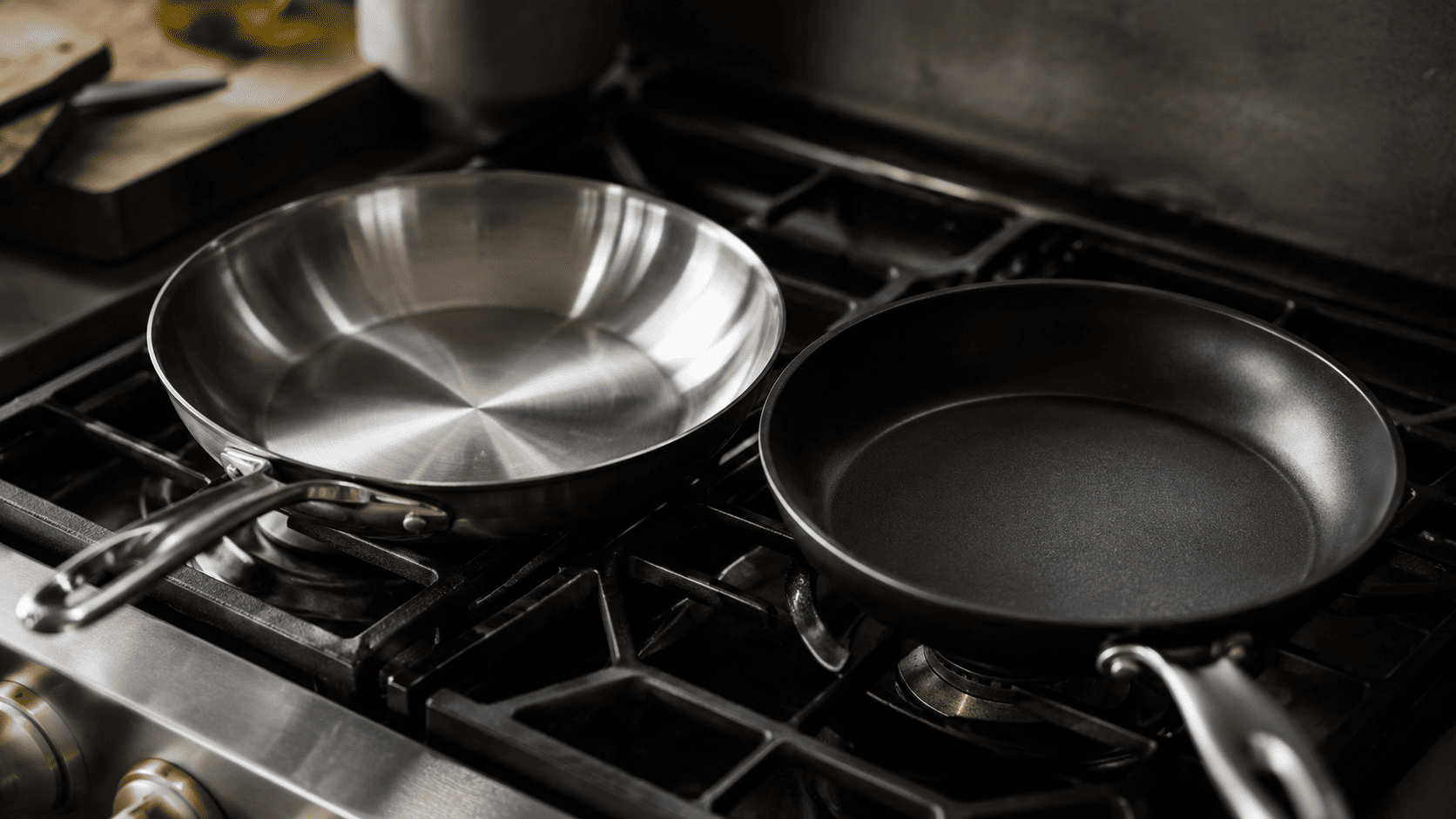
📷 Two pans, two completely different relationships with heat — and with your food.
There’s a specific sound that tells you which pan is in your hand before you’ve even looked down. The hard, bright scrape of a metal spatula against bare steel. Or the soft, slightly guilty silence of silicone gliding across a coated surface that would scratch if you used anything else.
Most kitchens own both, use one constantly, and feel a little unsure about why. The internet hasn’t helped. One camp insists stainless steel is the only “real” cookware and non-stick is a chemical compromise. The other insists eggs are a human right and stainless steel is a hobby for people who enjoy scrubbing.
Neither camp is entirely right. This guide separates the three things that actually matter — the surface chemistry, the safety question, and what you’re actually cooking tonight — so you can stop guessing and start matching the pan to the meal.
Why Food Sticks At All — And Why One Pan Fixes It Chemically
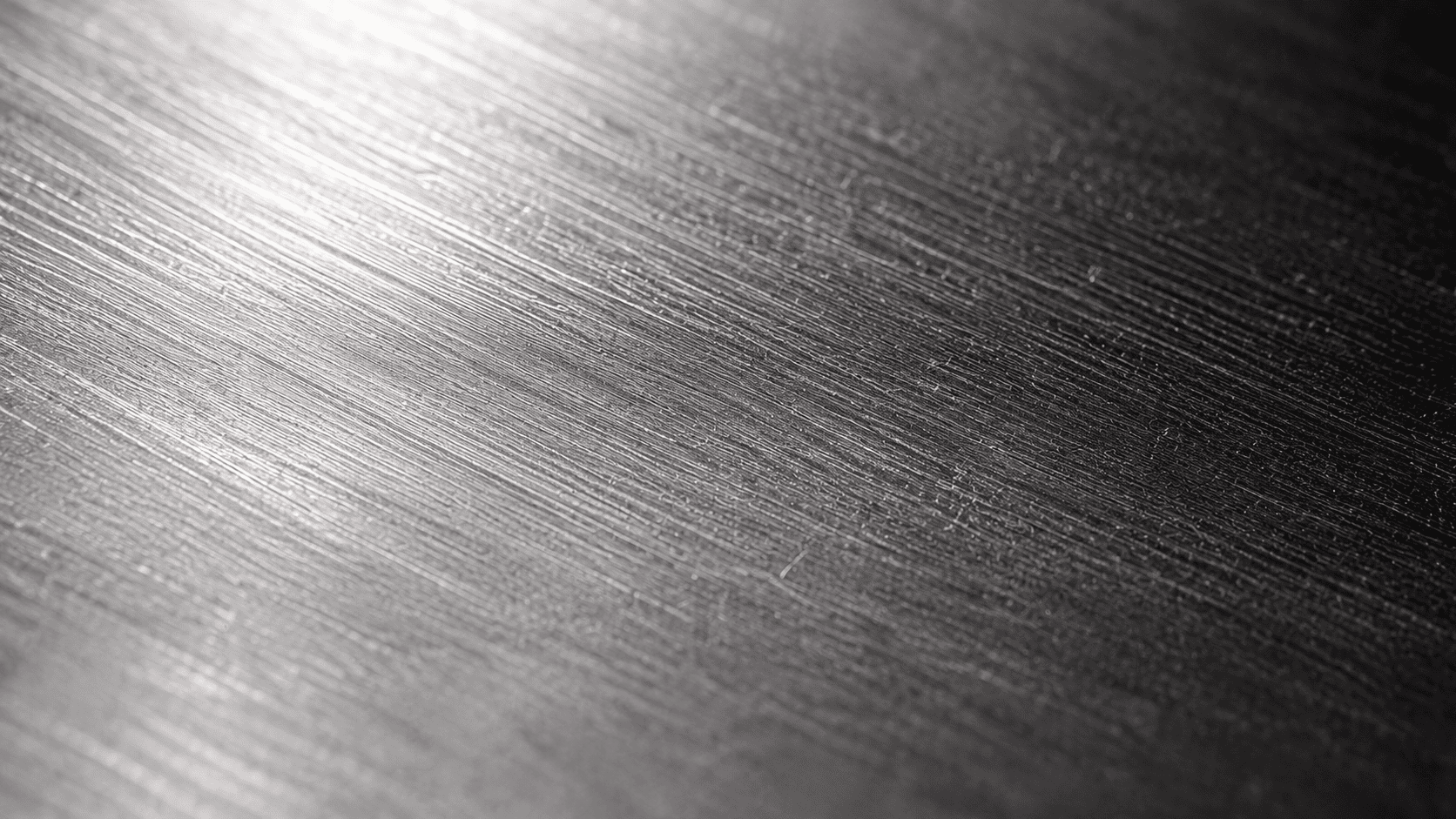
📷 The microscopic peaks and valleys that decide whether food bonds to the pan.
Zoom into any stainless steel surface and it stops looking smooth. Under magnification it’s a landscape of microscopic peaks and valleys — grain boundaries left behind by the rolling and polishing process. Proteins in food, especially egg whites and fish, form chemical bonds with the exposed metal at these high points the moment they touch a hot, dry pan.
That’s sticking, mechanically speaking: a protein-to-metal bond forming faster than a layer of fat can get between them. Non-stick coatings solve the problem by removing the bonding sites entirely. PTFE — the polymer most people know as Teflon — has one of the lowest coefficients of friction of any known solid. There’s almost nothing for a protein to grab onto.
PTFE (polytetrafluoroethylene) is a fluoropolymer chain of carbon atoms, each bonded to two fluorine atoms — a structure so chemically stable that almost nothing adheres to it, which is exactly what makes it useful as a non-stick coating and notoriously difficult to bond to anything else, including the pan itself.
Source: Tefal/Groupe SEB material science documentation; WHO/IARC fluoropolymer classification
Here’s the part that explains every frustrating egg-day: stainless steel isn’t broken when food sticks to it. It’s working exactly as designed. The fix isn’t a better pan — it’s getting the pan and the oil hot enough, fast enough, that a thin layer of fat fills those microscopic valleys before the protein ever gets the chance to bond directly with the metal.
The Maillard Question — Why Steakhouses Don’t Own a Non-Stick Pan
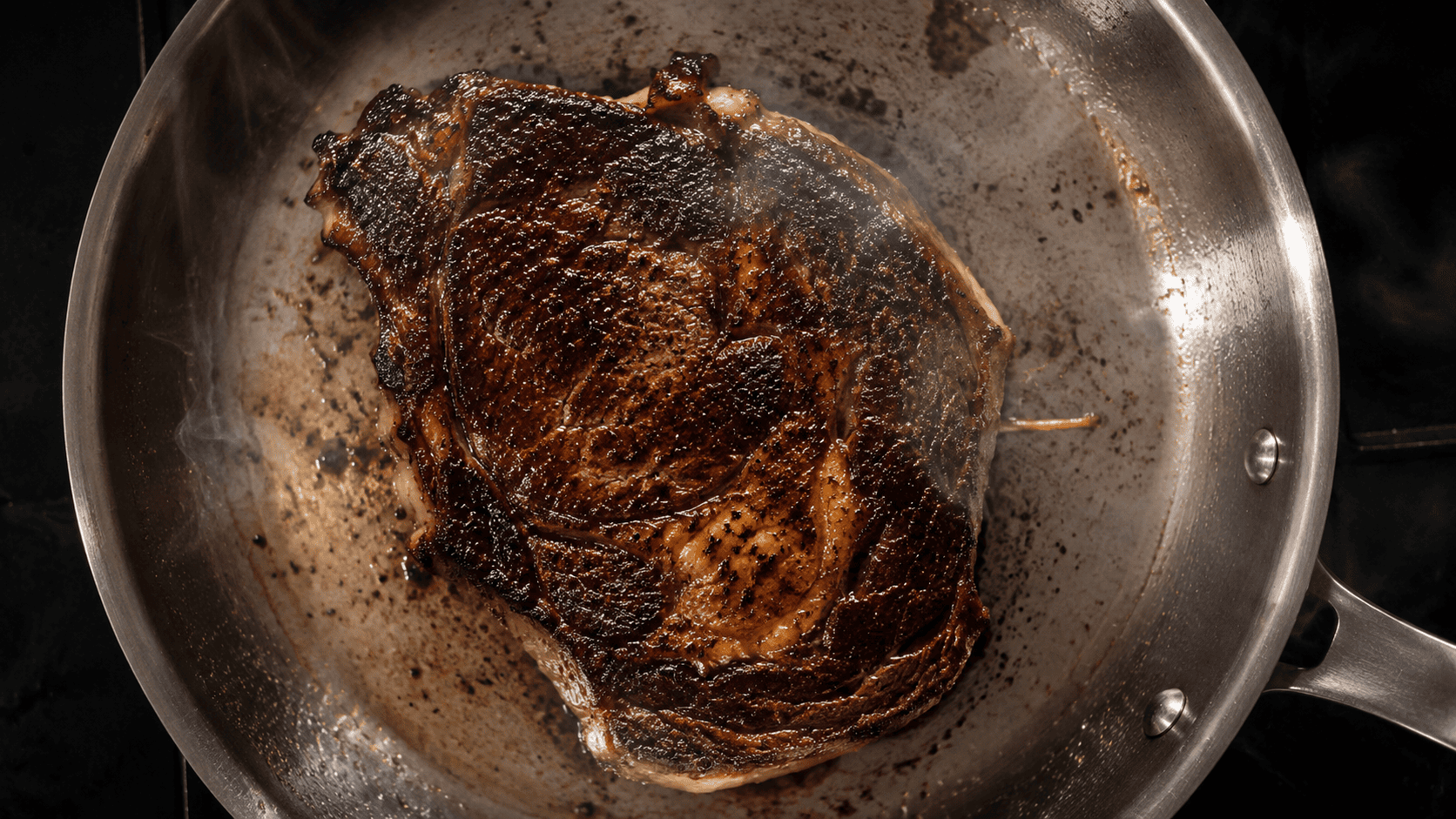
📷 The kind of crust that only happens above the Maillard threshold, held steady.
A proper sear isn’t decoration. It’s a chemical reaction between amino acids and sugars on the food’s surface, named for French chemist Louis-Camille Maillard, who first described it in 1912. The reaction needs heat — real, sustained heat — to produce the hundreds of new flavor compounds behind a brown crust.
The Maillard reaction starts around 250°F (120°C) and reaches peak efficiency between roughly 280–355°F (140–180°C). Below that range food simmers in its own moisture instead of browning; push too far past it and the crust turns bitter rather than complex.
Source: Harold McGee, food science research; Maillard reaction literature, 1912–present
This is where the two pans genuinely diverge, not just by reputation. Bare stainless steel has no coating to protect, so it can be brought to a screaming-hot 450–500°F and held there indefinitely. Most PTFE manufacturers advise staying at or below roughly 260°C (500°F) and recommend medium heat for daily use, because sustained high heat degrades the coating over time.
There’s also a thermal-mass issue most buying guides skip. A heavier, multi-ply stainless pan stores far more heat energy than a thin coated one — so when a cold steak hits the surface, the pan doesn’t lose 30–50°F in the first few seconds the way a thin pan does. That stored heat is what keeps the surface above the Maillard threshold long enough for a real crust to form, instead of the meat just steaming in its own juices.
Dry the food’s surface before it touches the pan — water has to evaporate before browning can start, and a wet surface stalls the whole reaction. Preheat the empty pan first, add oil, then add food once it shimmers. This single habit fixes more “my stainless steel pan is useless” complaints than any pan upgrade does.
The PFAS Conversation, Honestly — What the Tests Actually Found
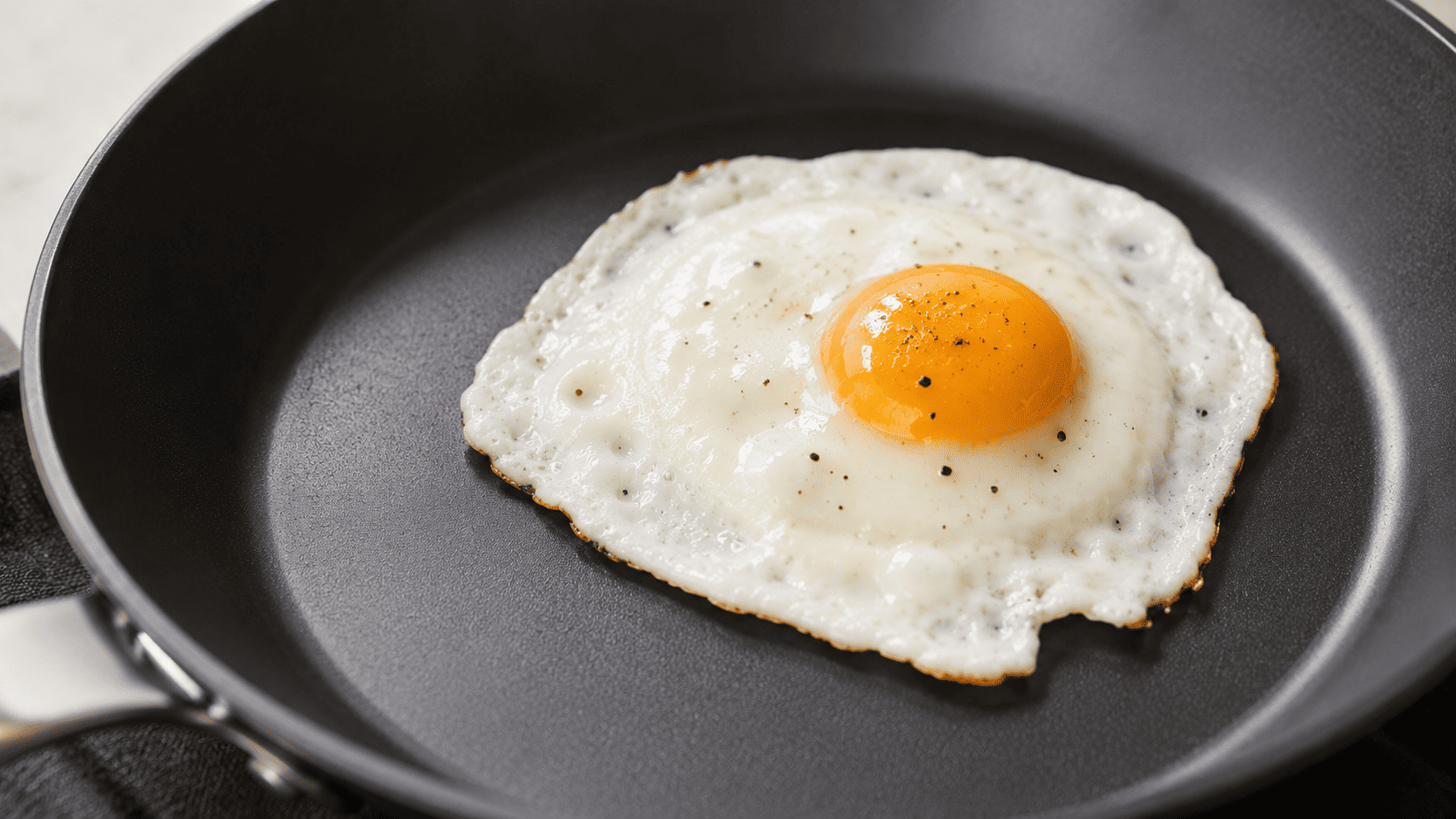
📷 A clean release, no coating breakdown required — the whole point of a non-stick surface.
Three acronyms get tangled together constantly, and clearing them up actually resolves most of the anxiety: PFAS is the umbrella family of roughly 5,000 “forever chemicals.” PTFE is the specific fluoropolymer used in Teflon-style coatings — and PTFE is technically a PFAS. PFOA was a separate processing chemical once used to manufacture PTFE, phased out of U.S. production by 2013–2015 after being linked to kidney and liver disease, thyroid disorders, and other health risks.
So “PFOA-free” — which is on virtually every nonstick pan sold today — is the legal baseline, not a meaningful safety claim. The pan can still be PTFE, and PTFE is still a PFAS, even with PFOA gone.
Consumer Reports tested three nonstick frying pans — one PTFE-coated, two ceramic-coated — for 96 different PFAS compounds. The PTFE pan showed measurable amounts of 16 of the 96 chemicals tested, including PFOA, despite the package claiming “PFOA-free.” Neither ceramic pan showed any of the 96 PFAS compounds tested.
Loria K. “You Can’t Always Trust Claims on ‘Non-Toxic’ Cookware.” Consumer Reports, Oct 2022.
The FDA’s own review of PFAS food-contact uses notes that the high heat used to bind PTFE coatings to cookware vaporizes off nearly all the smaller, migratable PFAS molecules, leaving a highly polymerized coating that studies show transfers only negligible amounts to food. The World Health Organization’s cancer research arm has also classified PTFE itself as not carcinogenic, distinguishing it from PFOA. The genuine risk window is narrower and more specific than headlines suggest: PTFE coatings can begin releasing fumes when heated empty above roughly 570–680°F for extended periods — well above any normal stovetop cooking temperature, but a real hazard if a pan is left empty on high heat and forgotten.
Stainless steel sidesteps this entire conversation because it has no coating to break down. That’s a genuine point in its favor for anyone who wants one less variable to think about — not because non-stick is dangerous in normal use, but because “no coating” is a simpler safety story than “coating that’s fine if you never overheat it empty.”
Lifespan, Cost & Real Maintenance — The Math Nobody Puts on the Box
A well-made stainless steel pan has no coating to wear out. Barring serious abuse, it lasts decades — which is why grandmothers hand them down and restaurant kitchens run the same pans for years. Non-stick coatings, by contrast, are a wear surface by design. Most home cooks see noticeable degradation within one to three years, faster with metal utensils, high heat, or dishwasher cycles.
vs. 1–3 years for most coated nonstick
vs. ~260°C / 500°F ceiling for PTFE
That changes the actual cost comparison. A quality tri-ply stainless pan costs more upfront but amortizes across a decade or more of use. A non-stick pan costs less per unit but functions more like a consumable — budget to replace it every couple of years rather than treating it as a one-time purchase.
Maintenance habits matter for both. Stainless steel wants hot water and, occasionally, a paste of baking soda for stuck-on browning — it can take metal utensils, high heat, and the dishwasher without complaint. Non-stick wants gentleness: wooden or silicone tools only, hand-washing preferred, and never the high-heat self-cleaning cycle of an oven if it’s oven-rated at all.
What to Cook in Which Pan — A Dish-by-Dish Decision Guide
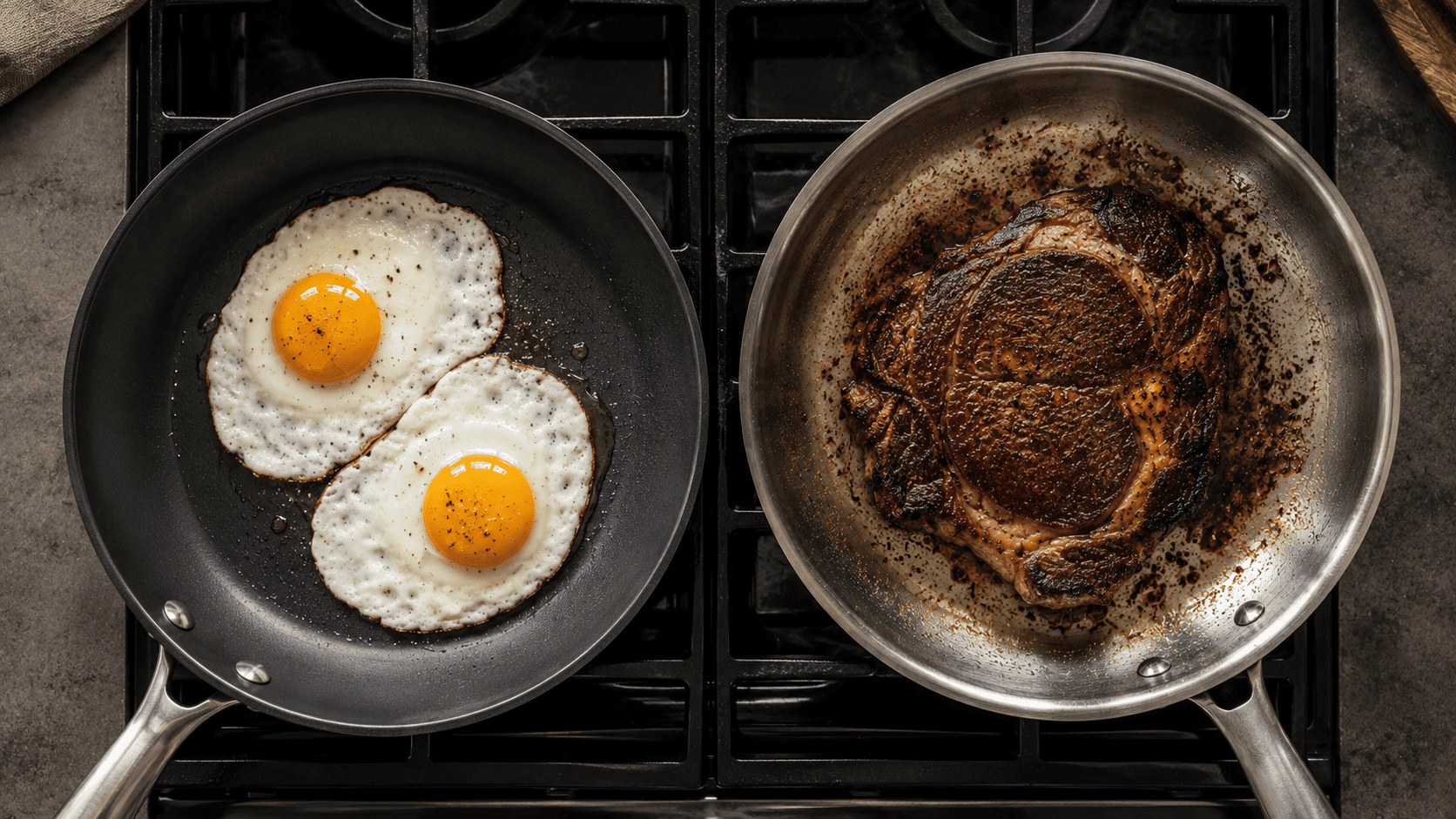
📷 Two jobs, two pans, side by side — the whole decision in one frame.
Most people don’t actually need to pick a side. They need to know which pan is reaching for which job — and most kitchens function best with both within arm’s reach.
Maximum Safe Cooking Temperature — Visualized
Approximate ceiling before coating degradation or performance loss. Bare metals are limited by smoke point of fat, not the pan itself.
Note: Stainless steel and cast iron have no coating to degrade — their practical ceiling is the smoke point of whatever fat is in the pan, not the metal itself.
What the Evidence Actually Supports
Strip away brand marketing and kitchen-forum tribalism, and four conclusions survive contact with the actual data.
5 Cookware Claims the Evidence Quietly Corrects
Cookware marketing is its own genre of overstatement. Here’s where the claims and the data actually part ways.
Stainless Steel vs. Non-Stick FAQ
So which pan wins? Neither, really — and that’s the actual answer the marketing copy on either side doesn’t want to give you. Stainless steel wins the sear. Non-stick wins the egg. The chemistry that makes each one good at its job is the same chemistry that makes it bad at the other.
Most kitchens that actually run smoothly don’t have one perfect pan. They have a steel one going hot and a coated one going gentle, both within reach, and a cook who’s stopped feeling guilty about owning both.