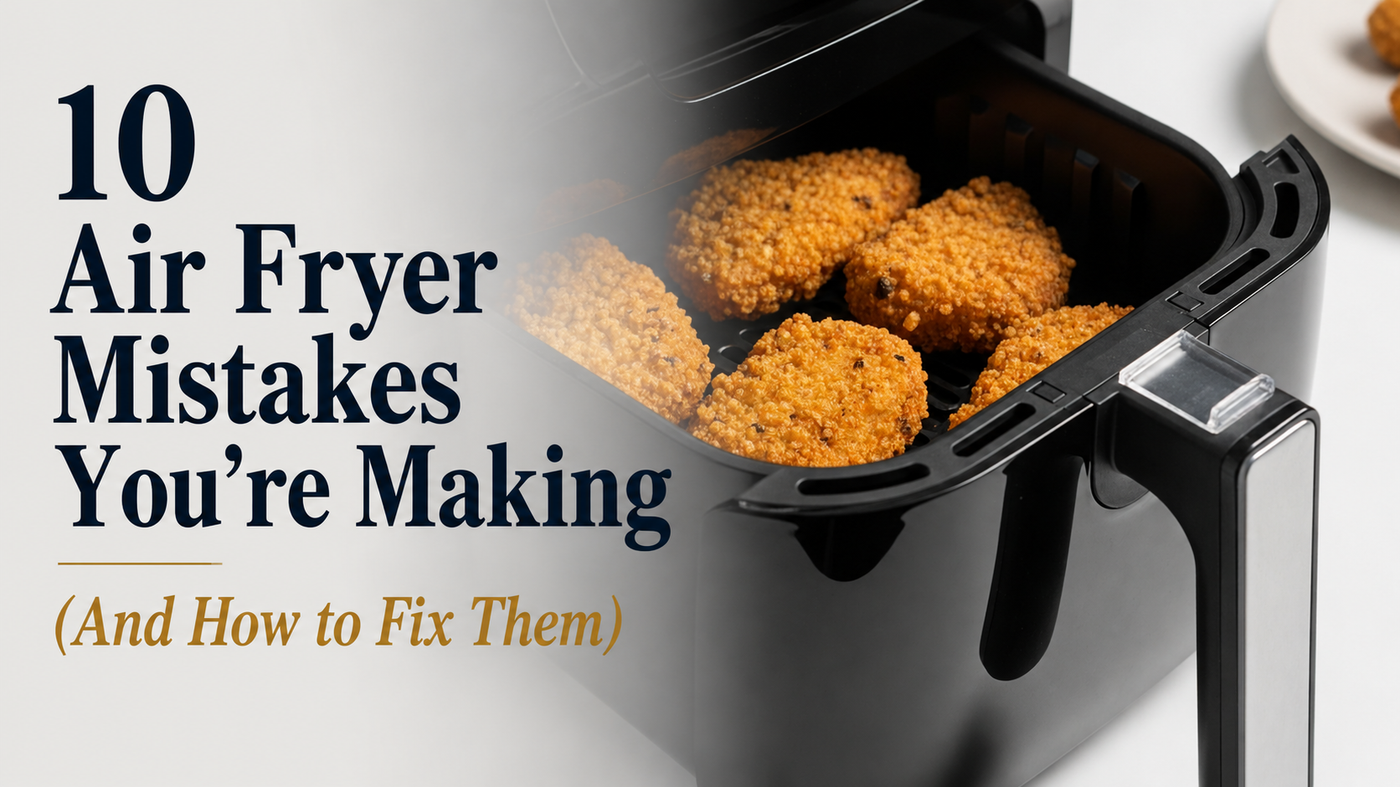
10 Air Fryer Mistakes You’re Making
(And How to Fix Them)
Most of the soggy, smoky, weirdly-pale disappointments coming out of air fryers trace back to one misunderstanding — and once you see it, nine of the other mistakes fix themselves.

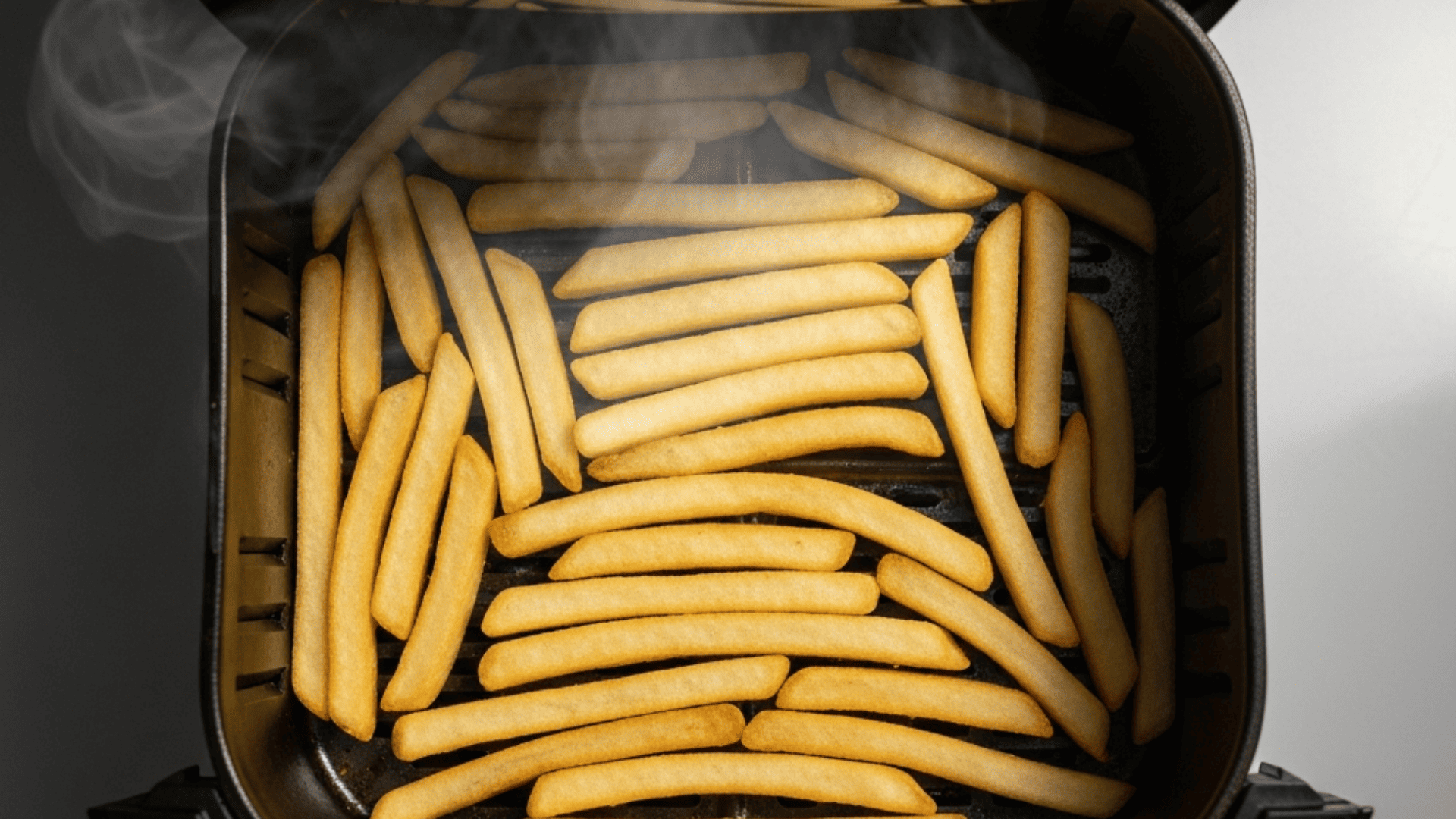
Single layer, gold not brown, a whisper of oil — that’s the whole game in one basket.
Nearly 60% of U.S. households now own an air fryer, and a remarkable number of them are being used slightly wrong. Not catastrophically. Just enough that the fries come out pale on one side, the chicken steams instead of crisps, and somewhere around week three the thing starts smelling faintly of last Tuesday.
Here’s the thing almost no one tells you when you unbox it: an air fryer is not a fryer. It’s a small, fast tabletop convection oven with brilliant marketing. Hot air, a fan, a perforated basket. That’s it.
Almost every mistake on this list comes from expecting it to behave like a vat of bubbling oil. Fix that one assumption and the food changes immediately. Below: the ten habits quietly sabotaging your basket, ranked roughly by how much damage they do — and the genuinely simple fix for each.
Overcrowding the Basket — The One Mistake Behind All the Soggy Ones
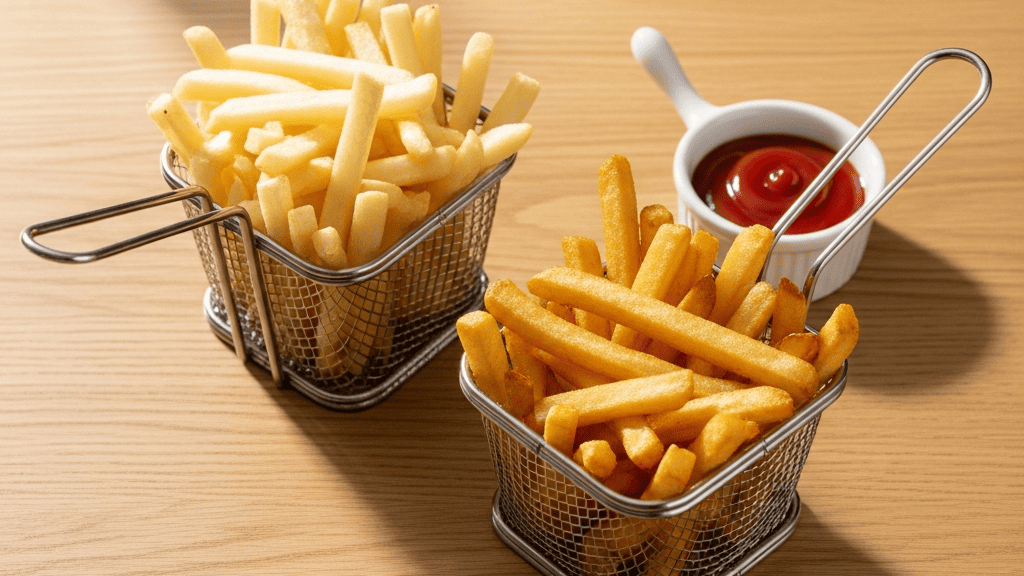
Left: a steamer. Right: an air fryer. Same machine, same fries.
The basket is doing exactly one job: moving hot air across every surface of the food. The moment you pile in a second layer, the air can’t reach the middle — so the food in there releases steam, and steam is the precise opposite of crisp. You’ve quietly turned a convection oven back into a vegetable steamer.
Because air fryers cook with fast-moving hot air in a small, confined space, food-safety guidance is blunt about it: they work best when food is in smaller pieces without overlapping. Crowding is the difference between “why is this pale and limp” and “oh, that’s what everyone’s talking about.”
One layer, with a little space between pieces. If that means cooking in two batches, cook in two batches — the second one only takes a few extra minutes, and the basket’s already hot. A slightly underfilled basket beats a crammed one every single time.
Skipping the Preheat — Why the First Few Minutes Decide Everything
Crisping is a fast surface reaction. It needs the food to hit hot air immediately, so the outside sears and seals before the inside has time to weep moisture. Drop food into a cold basket and those first few minutes go to heating the machine instead — long enough for the surface to soften and start steaming. By the time it’s hot, you’re already behind.
This matters most for the things you actually want crunchy: fries, wings, breaded anything, frozen snacks. For a slow roast of vegetables it matters less. But it’s three minutes, and it’s the cheapest upgrade in the kitchen.
Run it empty at your cooking temperature for 3–5 minutes before the food goes in. Many models have a preheat button; if yours doesn’t, just set the temp and start the timer. Add food to a basket that’s already roaring.
Never Shaking or Flipping — The Top Crisps, the Bottom Steams
Most baskets blow heat downward from above. So the top surfaces brown beautifully while the undersides — the bits pressed flat against the basket, sitting in their own released moisture — stay pale and a little damp. Walk away for the whole cook and you get one gorgeous side and one disappointing one.
It’s the most boring tip on this list and also one of the most reliable. Movement is what turns a tray of unevenly-cooked pieces into one uniformly crisp batch.
Shake small stuff (fries, sprouts, chickpeas) once or twice during the cook. Flip larger pieces (chicken, fish fillets, halloumi) at the halfway mark. Set a midpoint timer so you don’t forget — that single interruption is the difference between even and patchy.
Using No Oil — Or Drowning It in Oil
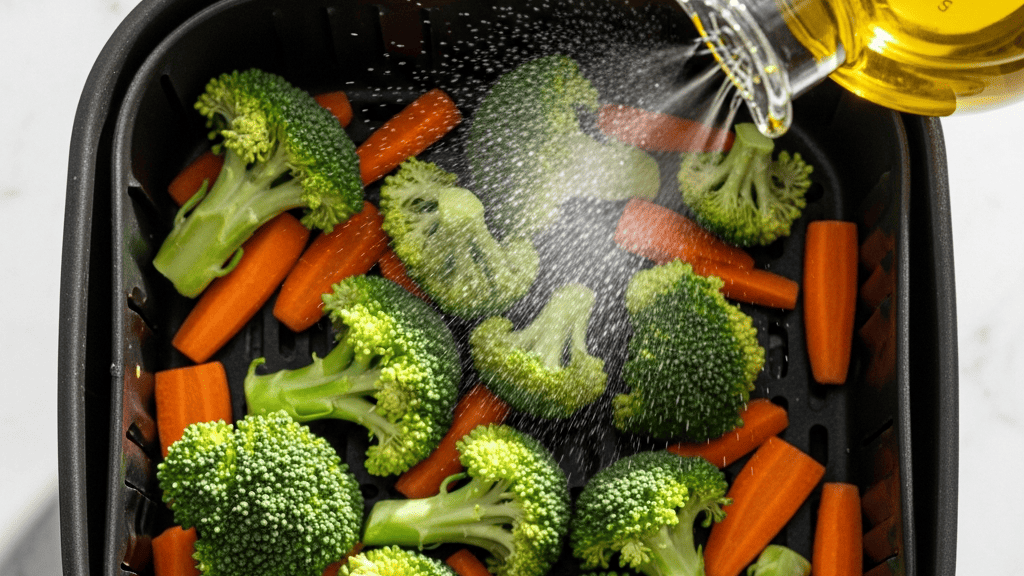
A light coat — not a puddle, not nothing.
“Oil-free” is half a myth. A whisper of oil is what carries heat across the surface, encourages even browning, and keeps food from sticking and tearing. Go completely dry and lean foods come out pale, leathery, and welded to the basket. But the opposite — dousing food like you’re deep-frying — pools oil at the bottom, smokes, and makes everything greasy and soft.
There’s a smaller, sneakier version of this mistake: aerosol cooking sprays. Many contain additives that, used heavily, can gum up and degrade a basket’s non-stick coating over time.
Toss food in roughly a teaspoon of oil in a bowl before it goes in, or use a refillable pump-style mister with your own oil. Pick something with a high smoke point — avocado, light olive, or refined sunflower. Skip the propellant aerosol cans on coated baskets.
Chasing Dark-Brown Crisp — Where Flavor Ends and Acrylamide Begins
Browning is information. The same golden color that signals “crispy” is also, chemically, a line you don’t want to sprint past. When starchy foods like potatoes and bread are cooked at high heat, natural sugars and an amino acid called asparagine react to form acrylamide — a compound that turns up the darker and longer food cooks.
The U.S. FDA is direct about it: cooking cut potato products to a golden yellow rather than a brown color helps reduce acrylamide, because the browner areas contain more of it. The European food-information body EUFIC adds the useful detail that acrylamide forms during the early stages of browning — long before food looks burnt — so “not charred” isn’t a low enough bar. Aim for light gold.
Sources: U.S. FDA, Acrylamide and Diet · EUFIC, Acrylamide Q&A · UK FSA “Go for Gold” guidance
The good news, and it’s real: air frying already produces far less acrylamide than deep frying, and a fraction of the fat. You’re starting from a better place. The mistake is undoing that advantage by blasting everything at maximum temperature until it’s mahogany.
Pull starchy foods at golden, not brown. For fries and chips, a 20–30°C lower temperature with a slightly longer time browns more gently and evenly. Soaking cut potatoes in cold water for 30 minutes (then drying them well) rinses off surface starch and cuts acrylamide further — and happens to make them crispier, too.
What Switching to Air Frying Actually Cuts
Approximate reductions vs. traditional deep-frying, for comparable foods. Ranges reflect that the numbers shift with the food and the temperature.
The appliance gives you a real head start. Mistake #8 is throwing it away.
Lining the Basket the Wrong Way — When Parchment and Foil Backfire
Lining the basket to save on cleanup is reasonable. Doing it badly causes two problems. First, a solid sheet of foil or parchment across the bottom covers the very holes the hot air needs to pass through — and you’re back to a steamer. Second, and more seriously: a loose, lightweight sheet of parchment with nothing on top of it can get lifted by the fan and blown straight onto the heating element, where it can scorch or catch.
This is the one mistake on the list that’s a genuine fire-safety issue, not just a texture one. It’s worth getting right.
Use perforated parchment liners made for air fryers (the ones full of holes), never a solid sheet. Only add the liner once food is going on top to weigh it down — never preheat with an empty loose liner inside. And never let foil or paper touch the heating element.
Cooking Wet Food — Surface Water Is the Enemy of Crunch
Water on the surface of food has to boil off before that surface can brown. So tofu straight from the packet, just-washed potatoes, or a chicken thigh swimming in marinade all spend their first minutes steaming themselves instead of crisping. You end up with soft, pale skin and a faintly poached texture.
There’s also a wet-batter version of this: thin, runny batters that work in hot oil simply drip through the basket and never set in an air fryer. They need a dry coating instead.
Pat food dry with a towel before it goes in — especially tofu, soaked potatoes, and anything marinated. Shake off excess marinade. For “fried” textures, use a dry breadcrumb or flour coating rather than a wet pourable batter.
Treating It as a Health Halo — The Appliance Is Neutral; the Food Isn’t
An air fryer reliably cuts the fat and calories of foods you’d otherwise deep-fry. That part is true. But it can’t transform what the food is. A bag of frozen fries reheated in hot air is still a bag of frozen fries — lighter, yes, but not a salad. The “I bought an air fryer so I eat healthy now” logic quietly skips over the frozen-nugget-shaped hole in the argument.
Here’s the more interesting truth, and it’s worth sitting with: the air fryer’s biggest health benefit was probably never the gadget itself. It was that it nudged a lot of people to cook at home at all — quickly, with little oil, on a weeknight they’d otherwise have ordered in. The machine is a habit, more than a health food.
Let the air fryer earn its counter space on real ingredients, not just freezer-aisle ones. Whole vegetables, fresh proteins, chickpeas, salmon, halloumi, a tray of roasted broccoli — that’s where the “healthy” story is actually true. Frozen snacks are fine; just don’t mistake them for the upgrade.
Never Actually Cleaning It — The Off-Flavors Have a Cause
That faint burnt smell, the wisp of smoke, the way last week’s fish keeps haunting this week’s cookies — that’s accumulated grease. Splattered oil collects on the basket, the drawer, and especially the heating element up top, where most people never look. Each cook re-heats it, which is what produces the smoke and the off-flavors. Left long enough, baked-on grease becomes a real fire risk.
The basket usually gets a rinse. The element almost never does — and that’s the part doing the smoking.
Wash the basket and tray after every use with warm soapy water (most are dishwasher-safe — check yours). Every week or two, unplug it, let it cool fully, and wipe the heating element with a damp cloth to lift greasy buildup. A clean machine smokes less and makes everything taste like itself.
Putting the Wrong Things In It — Light Foods, Loose Batter, Oversized Dishes
The same powerful fan that crisps your fries will also fling anything light around the chamber. A single leaf of kale, a slice of bread, a sheet of loose seasoning — up into the element it goes. And on the other extreme, wedging in a dish so big it covers the basket chokes the airflow that makes the whole thing work.
Secure light foods (a small trivet or a second rack helps), use dry coatings instead of wet batter, and choose fryer-safe dishes that leave clear space around the edges for air to move. When in doubt, the manual that came with your model is the actual authority — every air fryer’s geometry is a little different.
3 Air Fryer Beliefs the Kitchen Quietly Corrects
The three half-truths most responsible for disappointing results.
Air Fryer FAQ
The machine was never really the problem. Almost everything that goes wrong in an air fryer comes from one quiet misunderstanding — that it fries — and once you cook with it like the small, fast convection oven it is, the fixes stop feeling like rules and start feeling obvious. Single layer. A little oil. Gold, not brown. Move the food. Keep it clean.
Maybe that’s the real reason it caught on the way it did. Not because it made cooking foolproof, but because it made the good version so easy that the bad version started to feel like a choice. Get the basics right and it does, genuinely, hit different.